
Malt is the dominant freelance marketplace for Salesforce work in France and increasingly across Western Europe, yet most profiles on it read like a CV summary pasted into a form. The gap between a profile that generates inbound at €900/day and one that sits idle is almost never about credentials; it’s about positioning architecture.
These salesforce freelance consultant malt tips are not about gaming an algorithm. They’re about understanding how buyers on Malt actually make decisions, and structuring your profile to match that decision process rather than fight it.
How Malt Buyers Actually Evaluate Profiles
The typical buyer on Malt for a Salesforce engagement is either a Salesforce admin at a mid-market company who has been handed a project they can’t deliver alone, or a procurement manager at a larger org following a shortlist process. These two buyer types read profiles completely differently.
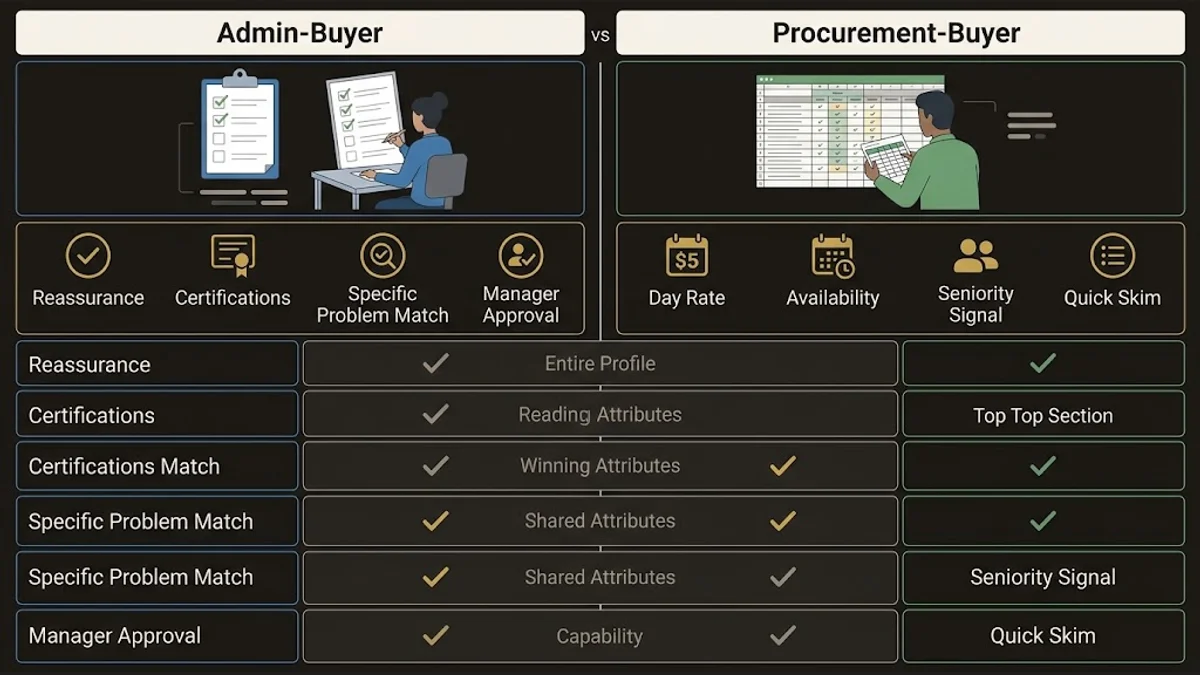
The admin-buyer is looking for reassurance. They want to see that you’ve solved their specific problem before. Certifications matter to them because certifications are legible signals they can show their manager.
The procurement buyer is running a comparison matrix. They’re looking at day rate, availability, and a rough seniority signal. They’ll skim your top three projects and stop reading.
Neither buyer reads your full profile. The architecture implication: your first 300 characters of headline and tagline need to do all the heavy lifting. “Salesforce Consultant | 8 years | CRM | Sales Cloud | Service Cloud” is not positioning. It’s a list. “Salesforce Architect specializing in multi-cloud unification for mid-market retail and financial services” is a position. It tells the buyer whether you’re for them before they’ve clicked anything.
The Profile Structure That Converts
Most Malt profiles fail at the same structural level: they describe what the consultant has done rather than what the client will get. This is the single most common positioning error, and it compounds across every section.
Headline: State your specialization and the outcome you deliver, not your job title. “Salesforce Technical Architect; Sales Cloud, Service Cloud, Data Cloud integrations for orgs scaling past 500 users” outperforms “Senior Salesforce Consultant” in every buyer segment.
About section: Lead with the problem you solve, not your career history. Buyers don’t care that you started in 2016 with a small integrator. They care whether you’ve handled the complexity they’re facing. Two sentences on the problem, two on your approach, one on your delivery model.
Skills: Malt’s search algorithm weights skills tags heavily. Be precise. “Salesforce” as a tag is noise. “Agentforce,” “Data Cloud,” “Flow,” “Apex,” “CPQ” are signals. Tag the specific features you can architect, not the platform category.
Projects: Three to five projects, each structured as problem-approach-outcome. Quantify where possible. “Reduced case resolution time by 35% via Service Cloud Einstein case routing” is citable. “Implemented Service Cloud for a retail client” is not.
The in-house vs. freelance Salesforce architect comparison is worth understanding here because it shapes how you position against the alternative buyers are considering. You’re not just competing with other freelancers; you’re competing with the option of hiring someone full-time.
Day Rate Positioning and the Anchoring Problem
Malt displays your day rate prominently. Most consultants underprice because they anchor to what they were earning as an employee, or to what they charged when they started freelancing. Both anchors are wrong.
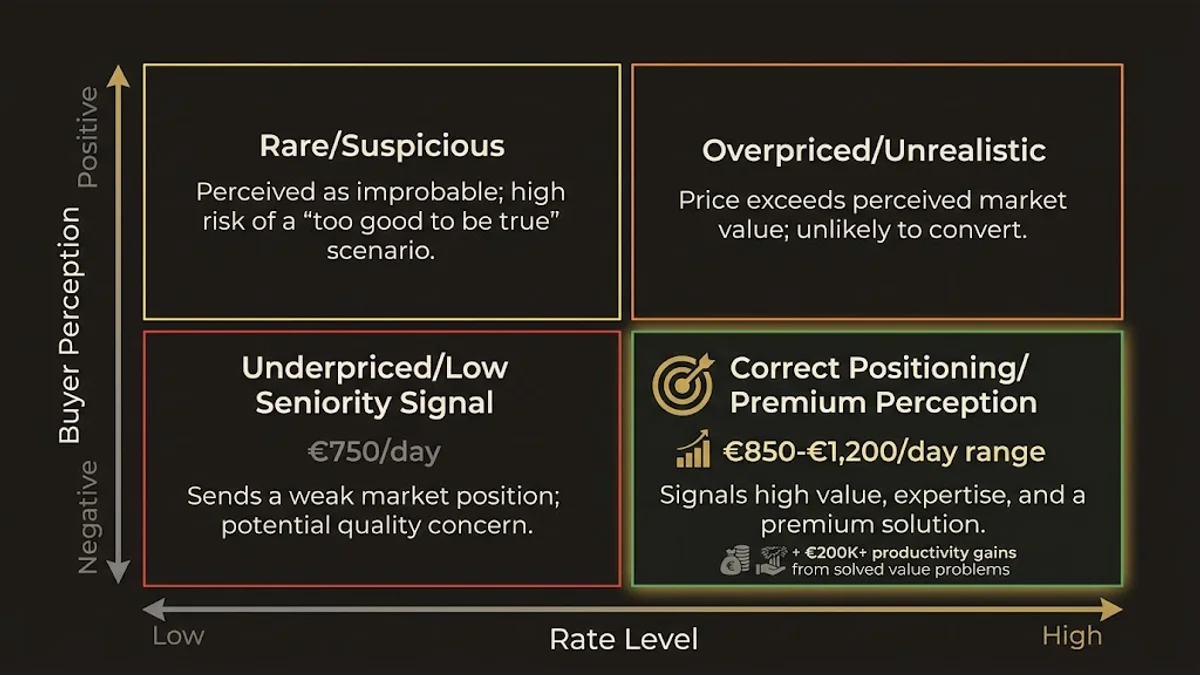
The correct anchor is the value of the problem you solve. A Salesforce org with broken automation costing a sales team 3 hours per week across 50 reps is a €200K+ annual productivity problem. An architect who fixes that in 10 days at €1,000/day is a bargain. Price to the problem, not to your comfort level.
In practice, the Malt market for senior Salesforce architects in France in 2026 sits between €850 and €1,200/day depending on specialization. Data Cloud and Agentforce specialists command the upper end because supply is genuinely constrained. If you have those skills and you’re pricing at €750, you’re leaving money on the table and, counterintuitively, signaling lower seniority to procurement buyers who use rate as a quality proxy.
Raise your rate before you feel ready. The worst outcome is a negotiation that lands you at your current rate. The best outcome is that buyers stop questioning your seniority.
Response Time and Availability Signals
Malt’s algorithm surfaces profiles with recent activity and fast response times. This is a mechanical reality, not a soft preference. Consultants who respond to inquiries within two hours get significantly more visibility than those who respond in 48 hours.
The practical architecture for this: set Malt notifications on your phone, treat the first response as a 15-minute task, and keep a template for the initial reply that asks two qualifying questions. You’re not committing to anything; you’re keeping the conversation alive while you evaluate fit.
Availability status matters more than most consultants realize. “Available immediately” generates more inbound than “available in 3 months,” obviously, but the less obvious insight is that updating your availability date regularly signals an active profile. Even if you’re booked, updating to “available from [next month]” keeps your profile from going stale in the algorithm.
Recommendations and Social Proof Architecture
Malt’s recommendation system is underused by most Salesforce consultants. A profile with six detailed recommendations from named clients at recognizable companies converts at a materially higher rate than a profile with two generic ones.
The mechanics: ask for recommendations immediately after project completion, when the client’s satisfaction is highest and the work is fresh. Give them a framework. “If you could mention the specific problem we solved, the approach we took, and the outcome you saw, that would be most useful” produces better recommendations than an open-ended request.
Specificity in recommendations does the same work as specificity in your project descriptions. “Sébastien delivered the project on time” is noise. “Sébastien redesigned our lead-to-opportunity process in Sales Cloud, cutting our sales cycle from 45 to 28 days” is a conversion asset.
One structural note: recommendations from technical peers (other architects, CTOs) carry different weight than recommendations from project sponsors. Both matter. Technical recommendations signal craft; sponsor recommendations signal business impact. Aim for a mix.
Specialization Beats Generalism at Every Rate Level
The most common mistake senior Salesforce consultants make on Malt is positioning as generalists to maximize the pool of potential clients. The logic seems sound: more scope means more opportunities. In practice, it produces the opposite result.
Buyers searching for help with a specific problem; a Data Cloud implementation, an Agentforce deployment, a CPQ migration; filter for specialists. A profile that says “I do everything Salesforce” reads as “I’m not the best at any of it.” A profile that says “I architect Data Cloud implementations for financial services orgs” reads as “this person has solved my exact problem before.”
The narrower your stated specialization, the higher the rate you can justify, and the less price negotiation you face. Generalist profiles attract price-sensitive buyers who are comparison shopping. Specialist profiles attract buyers who have already decided they need a specific skill and are evaluating whether you have it.
This is the same logic that applies to the broader freelance positioning question covered in the Salesforce architect vs. consultant difference breakdown. Architect-level positioning commands architect-level rates, regardless of what your previous employer called your role.
For consultants building toward that positioning, the /services/org-health-recovery work pattern is a useful specialization anchor: orgs in distress have urgent, well-defined problems and are less price-sensitive than orgs in planning mode.
The Forward-Looking Rate Problem
Malt profiles are static documents in a market that’s moving fast. The Salesforce skills that commanded premium rates in 2023 (basic Sales Cloud configuration, standard Flow automation) are now commoditized. The skills commanding premium rates in 2026 are Agentforce architecture, Data Cloud identity resolution, and multi-cloud integration design.
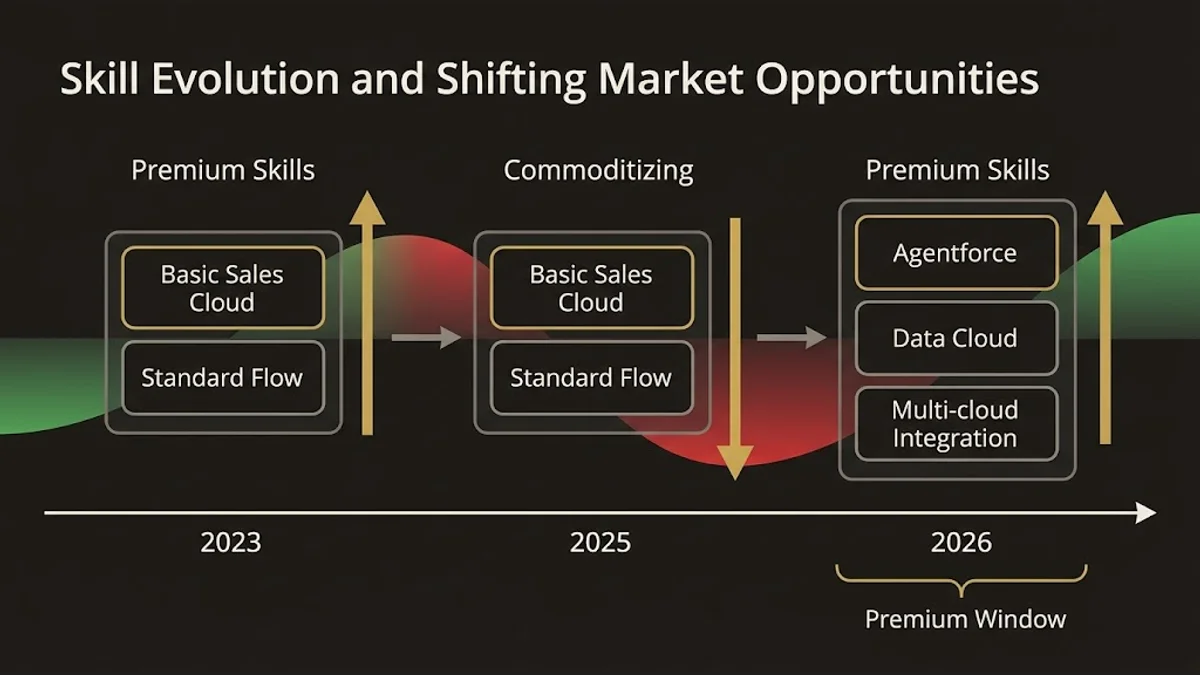
A profile optimized for 2023 skills will generate declining inbound through 2026 and 2027 as more consultants enter those commodity tiers and buyers’ expectations shift upward. The consultants who update their profiles to reflect current platform capabilities before those capabilities become mainstream will capture the premium window.
Concretely: if you’ve done any Agentforce work, even internal exploration or certification prep, that belongs on your profile now. The Atlas Reasoning Engine, Topics and Actions configuration, Prompt Builder template design; these are searchable terms that buyers are starting to use. Being findable for them before the market is saturated is a positioning advantage with a limited shelf life.
Key Takeaways
- Headline and tagline do 80% of the conversion work on Malt; treat them as positioning statements, not job title fields.
- Price to the problem you solve, not to your employment history. Senior Salesforce architects in France in 2026 command €850-€1,200/day; pricing below that signals seniority problems to procurement buyers.
- Specialization generates higher rates and less price negotiation than generalist positioning, at every experience level.
- Response time under two hours and regular availability updates are mechanical algorithm inputs, not soft preferences.
- Update your profile for Agentforce and Data Cloud skills now, before those capabilities become commodity search terms. The premium window for early movers is real but finite.