The Salesforce Summer ‘26 release is not a feature drop you can defer to Q4 planning. Multi-agent orchestration changes how you design agent topology. Slack-first workflows shift where business logic lives. Real-time Data Cloud capabilities rewrite the assumptions under your activation latency targets. If your enterprise rollout plan was built on Spring ‘26 architecture, it needs revision now.
What Multi-Agent Orchestration Actually Changes
The architectural shift in Summer ‘26 is the promotion of agent-to-agent delegation from experimental to production-grade. The Atlas Reasoning Engine now supports explicit orchestrator-worker topologies, where a coordinating agent decomposes a goal, delegates subtasks to specialized worker agents, and synthesizes results before responding to the user or triggering a downstream action.
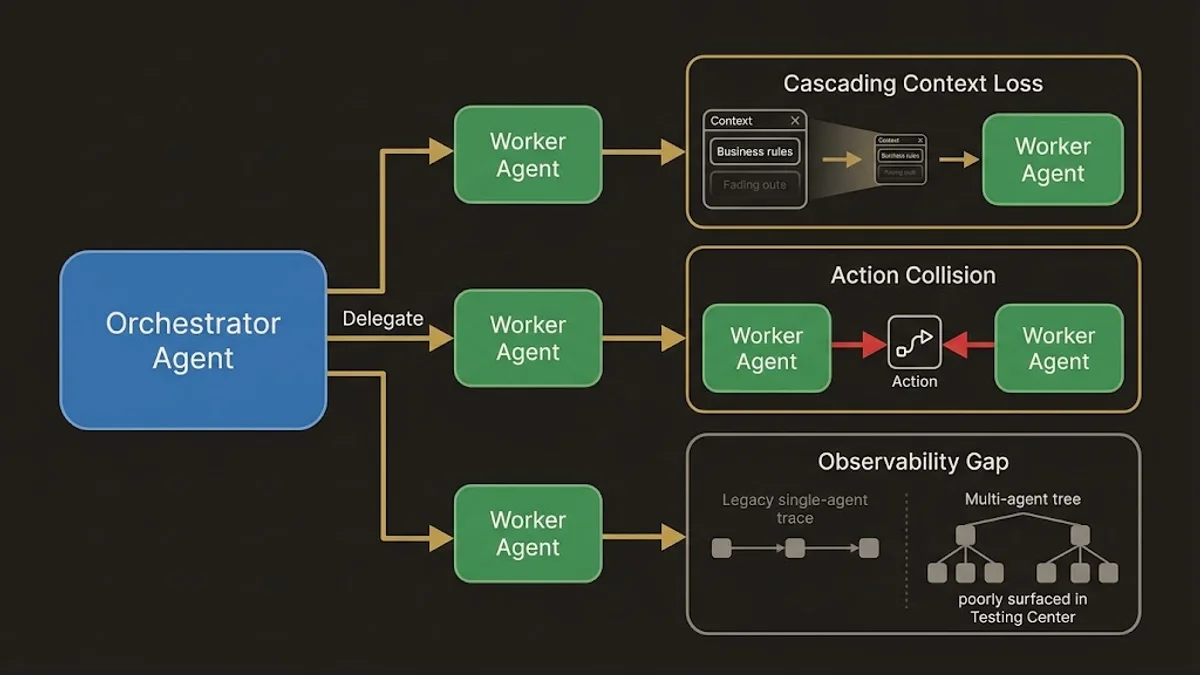
This sounds clean in a demo. In production, it introduces a class of failure modes that single-agent architectures never had to handle.
The first is cascading context loss. When an orchestrator agent passes a task to a worker, the context window does not transfer in full. Topics and Instructions scoped to the orchestrator are not automatically inherited by the worker. In practice, this means worker agents operating without the business rules their orchestrator assumed were in scope. The fix is explicit: every worker agent needs its own complete Instruction set, and shared business rules belong in a centralized Prompt Builder template referenced by both.
The second is action collision. In orgs where multiple agents share access to the same Actions (a Flow that updates an Opportunity stage, for example), concurrent execution from an orchestrator dispatching parallel workers creates race conditions. The architecture that works here is action ownership: each Action is registered to exactly one agent tier, and cross-tier invocations go through a defined handoff, not direct execution.
The third is observability. Single-agent interactions produce a linear trace. Orchestrator-worker graphs produce a tree, and the Agentforce Testing Center’s current tooling surfaces that tree poorly. Until native graph tracing matures, instrument your orchestration flows with Platform Events at each delegation boundary. That gives you a queryable audit trail independent of the agent framework’s own logging.
For orgs planning to deploy multi-agent patterns at scale (think contact center automation across 50+ queues, or field service orchestration across regional agent pools), the TDX 2026 multi-agent orchestration guide maps the dependency model that Summer ‘26 builds on. The topology decisions made there are now executable, not just theoretical.
Slack-First Workflows and Where Business Logic Belongs
Summer ‘26 formalizes Slack as an agent interaction surface, not just a notification channel. Agents can now receive structured inputs from Slack, execute Actions, and return formatted responses within a thread, without routing through a Salesforce UI at all.
The architectural question this raises is not “should we use Slack agents?” It is “where does the business logic live when Slack is the primary surface?”
The wrong answer is embedding logic in Slack workflow steps. Slack workflows are good at routing and notification. They are not a governance layer. Business rules that live in Slack-native automation are invisible to your Salesforce audit trail, untestable in the Agentforce Testing Center, and fragile when Slack API versions change.
The right answer is thin Slack surfaces backed by Salesforce-native Actions. The Slack interaction captures intent and structured input. An Agentforce Action executes the logic. The response returns to Slack. This keeps your business logic in a governed, versionable, testable layer while giving users the Slack experience they want.
There is a latency implication. Slack-to-Agentforce-to-Slack round trips add 1-3 seconds compared to native Slack automation. For approval workflows and async processes, this is irrelevant. For real-time conversational agents where users expect sub-second responses, you need to pre-compute as much state as possible in Data Cloud Calculated Insights so the agent is retrieving, not computing, at response time.
The Slack-first pattern also changes your identity model. Users interacting via Slack are authenticated to Slack, not necessarily to Salesforce. Summer ‘26 introduces Slack-to-Salesforce identity bridging, but the mapping is not automatic. You need explicit Identity Resolution configuration that links Slack user IDs to Salesforce Contact or User records. Orgs that skip this step will have agents operating without a resolved Customer 360 profile, which means personalization fails silently.
Real-Time Data Cloud Features and What They Demand from Your Architecture
The Summer ‘26 Data Cloud updates compress the latency between event ingestion and segment membership recalculation. The practical ceiling for real-time activation in enterprise orgs with complex Identity Resolution rulesets has historically been 2-5 minutes from event to segment update. Summer ‘26 targets sub-60-second recalculation for high-priority segments.
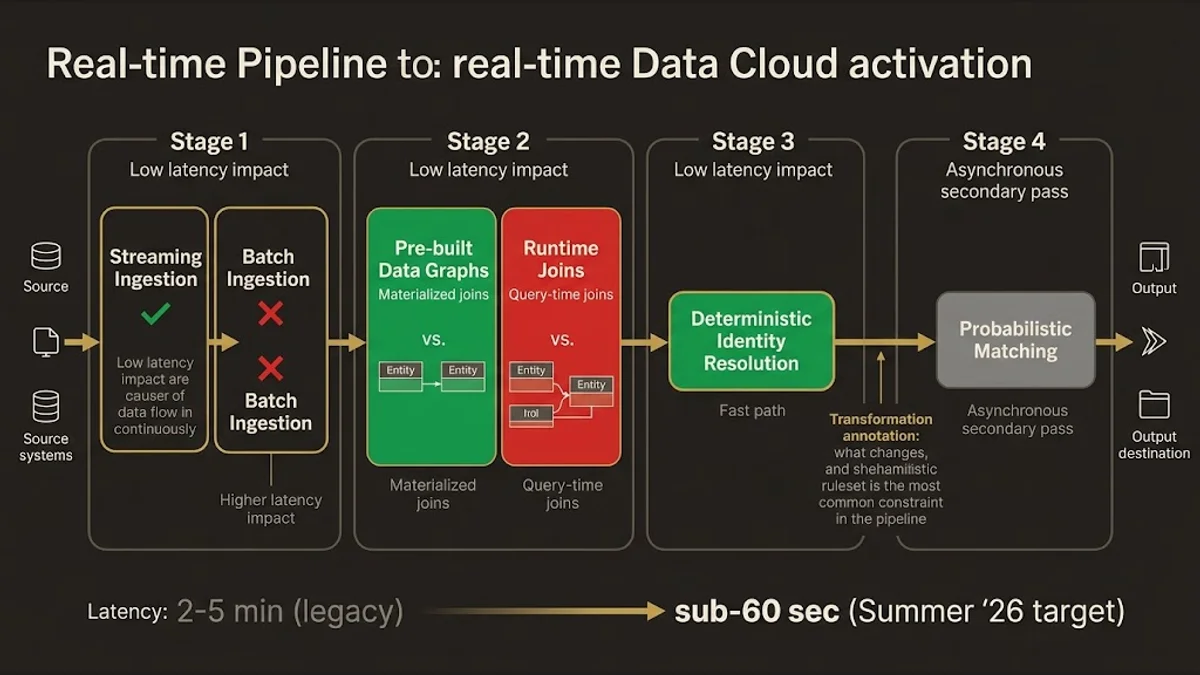
That number is achievable, but only under specific architectural conditions.
Data Streams feeding real-time segments must use streaming ingestion, not batch. This sounds obvious, but a significant portion of enterprise Data Cloud implementations use scheduled batch Data Streams even for event data, because batch was the path of least resistance during initial setup. If your Data Streams are batch-scheduled, sub-60-second recalculation is not available to you regardless of what Summer ‘26 enables at the platform level.
Data Graphs need to be pre-built for the entity relationships your segments query. A segment that joins Unified Individual to Order to Product at query time will not hit the sub-60-second target. The join needs to be materialized in a Data Graph ahead of the segment evaluation. This is a design-time decision, not a runtime optimization.
Identity Resolution rulesets are the most common bottleneck. Complex fuzzy matching across email, phone, and device identifiers adds processing time that compounds at scale. The architecture that holds up under Summer ‘26’s real-time targets uses deterministic matching as the primary ruleset and reserves probabilistic matching for a secondary reconciliation pass that runs asynchronously. Trying to run full probabilistic Identity Resolution in the hot path of a real-time segment recalculation will consistently miss the latency target.
For orgs where Data Cloud is the foundation layer for Agentforce personalization, the data-cloud-agentforce-foundation-architecture article covers the dependency chain between Data Cloud profile freshness and agent response quality. Summer ‘26 makes that dependency more consequential, not less, because faster recalculation means agents can now act on stale profiles in ways that were previously masked by longer latency windows.
Enterprise Rollout Planning Implications
Summer ‘26 features are not uniformly available at GA. Multi-agent orchestration in production-grade form requires Agentforce for Enterprise licensing. Real-time Data Cloud recalculation at sub-60-second targets requires Data Cloud Plus. Slack-first agent surfaces require the Slack for Salesforce advanced integration tier. Orgs that plan rollouts without confirming license entitlements against feature availability will hit walls mid-implementation.
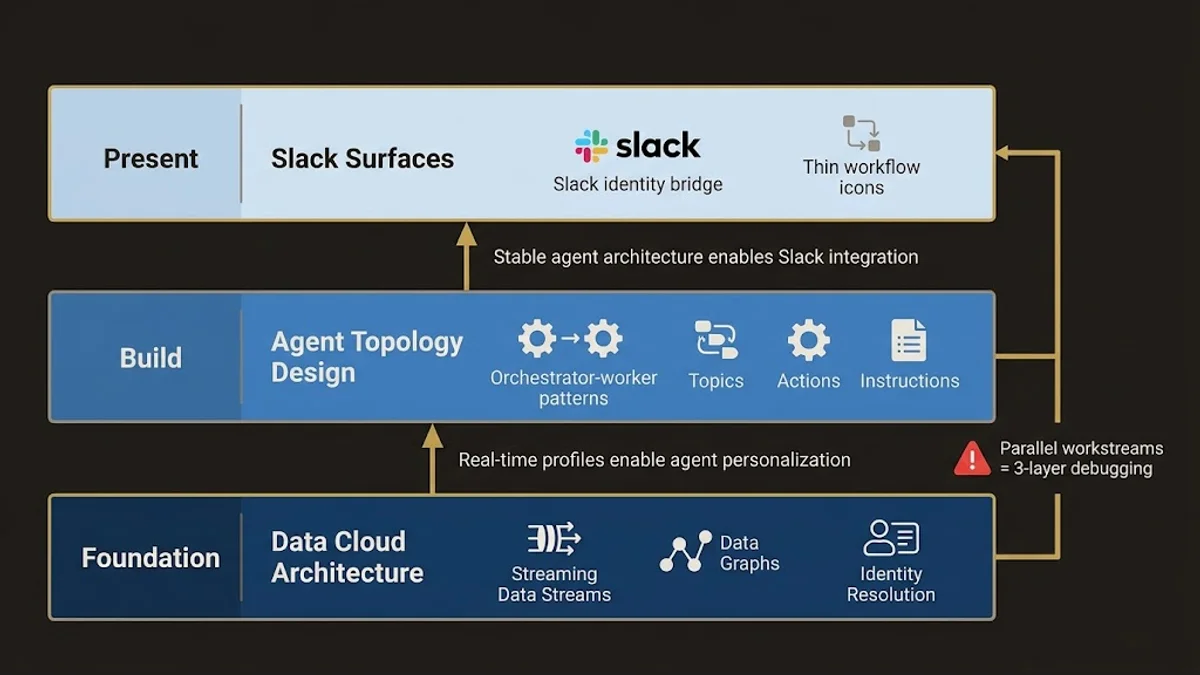
The sequencing that works for enterprise rollout is: Data Cloud architecture first, agent topology second, Slack surfaces third.
Real-time Data Cloud is the foundation. Without streaming Data Streams, pre-built Data Graphs, and optimized Identity Resolution rulesets, neither multi-agent orchestration nor Slack-first workflows can deliver on their promise. Agents operating on stale or unresolved profiles produce confident-sounding wrong answers, which is worse than no agent at all.
Agent topology comes second because the orchestrator-worker patterns in Summer ‘26 require deliberate design. Retrofitting a single-agent deployment into a multi-agent topology after go-live is significantly more disruptive than designing for it from the start. The Topics, Actions, and Instructions architecture needs to account for delegation boundaries before the first agent goes live.
Slack surfaces come last because they are the presentation layer. Getting the Slack identity bridge right, designing thin Slack workflows backed by Salesforce-native Actions, and tuning response latency are all easier problems when the underlying agent and data architecture is stable.
Orgs attempting to run all three workstreams in parallel without a clear dependency map will find that Slack surface issues mask agent logic issues, which mask data quality issues. The failure mode is a three-layer debugging problem with no clean separation. The Salesforce agentforce implementation guide covers the sequencing logic that applies here, and Summer ‘26 does not change that fundamental order of operations.
One forward-looking consideration: Summer ‘26’s multi-agent capabilities will accelerate the consolidation of agent governance into a dedicated architectural role. Orgs that treat agent design as a configuration task handled by admins will accumulate agent technical debt at a rate that makes org technical debt look manageable by comparison. The complexity of orchestrator-worker topologies, action ownership models, and real-time data dependencies requires architectural oversight, not just configuration governance. The orgs that establish that oversight now will have a significant advantage when Summer ‘27 adds another layer of capability on top of what Summer ‘26 introduces.
Key Takeaways
- Multi-agent orchestration in Summer ‘26 introduces cascading context loss and action collision risks that require explicit architectural mitigations: complete Instruction sets per worker agent, action ownership by tier, and Platform Event instrumentation at delegation boundaries.
- Slack-first workflows belong as thin surfaces backed by Salesforce-native Actions; business logic embedded in Slack-native automation is ungoverned and untestable.
- Sub-60-second Data Cloud segment recalculation requires streaming Data Streams, pre-built Data Graphs, and deterministic-first Identity Resolution rulesets. Batch ingestion and runtime joins will not hit the target regardless of platform capability.
- Sequence enterprise rollout as Data Cloud architecture, then agent topology, then Slack surfaces. Parallel workstreams without dependency mapping produce three-layer debugging problems.
- Confirm license entitlements before committing to Summer ‘26 feature timelines. Multi-agent orchestration, real-time Data Cloud, and Slack agent surfaces each require specific licensing tiers that are not included in base Agentforce or Data Cloud contracts.