
The Salesforce Momentum Einstein competitive strategy isn’t about adding a feature. It’s about changing the category Salesforce competes in. That distinction matters more than most enterprise buyers currently recognize.
For the past five years, Gong and Chorus have owned a specific problem: what actually happens in sales conversations, and how that signal connects to revenue outcomes. Salesforce watched from the side, offering Einstein Activity Capture and Conversation Insights as adjacent tools rather than a coherent answer. Momentum changes that calculus. Not immediately, and not without execution risk; but structurally, the acquisition shifts where the competitive battle is fought.
Why Gong’s Moat Was Never About Transcription
The surface-level read on Gong is that it records and transcribes calls. That’s wrong. The actual moat is the behavioral signal layer sitting underneath: deal risk scores derived from conversation patterns, rep coaching triggers based on talk-time ratios, forecast adjustments tied to sentiment drift across a deal cycle. Transcription is the input. The intelligence layer is the product.
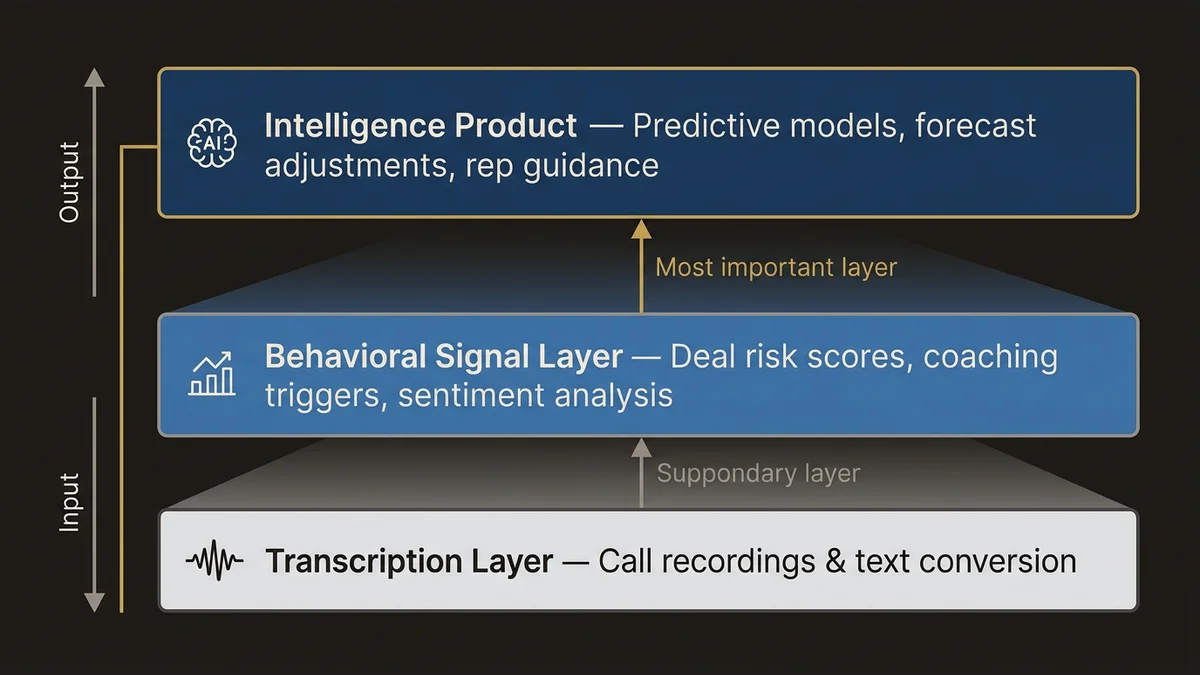
Chorus built a similar stack, which is why Zoom acquired it. The pattern is consistent: conversation data at scale produces a behavioral model of how deals move, stall, and die. That model is worth more than the recordings.
Salesforce’s problem wasn’t that Einstein lacked AI. Einstein has had NLP capabilities, opportunity scoring, and activity tracking for years. The problem was that Einstein’s signal came from CRM data; what reps logged, what emails were sent, what stages were updated. That’s lagging data. By the time it surfaces in Einstein, the deal has already moved.
Momentum’s signal is leading. Conversation intelligence captures what’s happening before it gets logged, before it gets sanitized by the rep’s interpretation, before the forecast call. That’s the gap Salesforce was trying to close.
What Momentum Actually Adds to the Einstein Stack
The architectural question is where Momentum’s intelligence lands inside Salesforce’s platform. Based on the acquisition pattern and Salesforce’s existing infrastructure, the most defensible integration path runs through Data Cloud and Agentforce, not Einstein standalone.
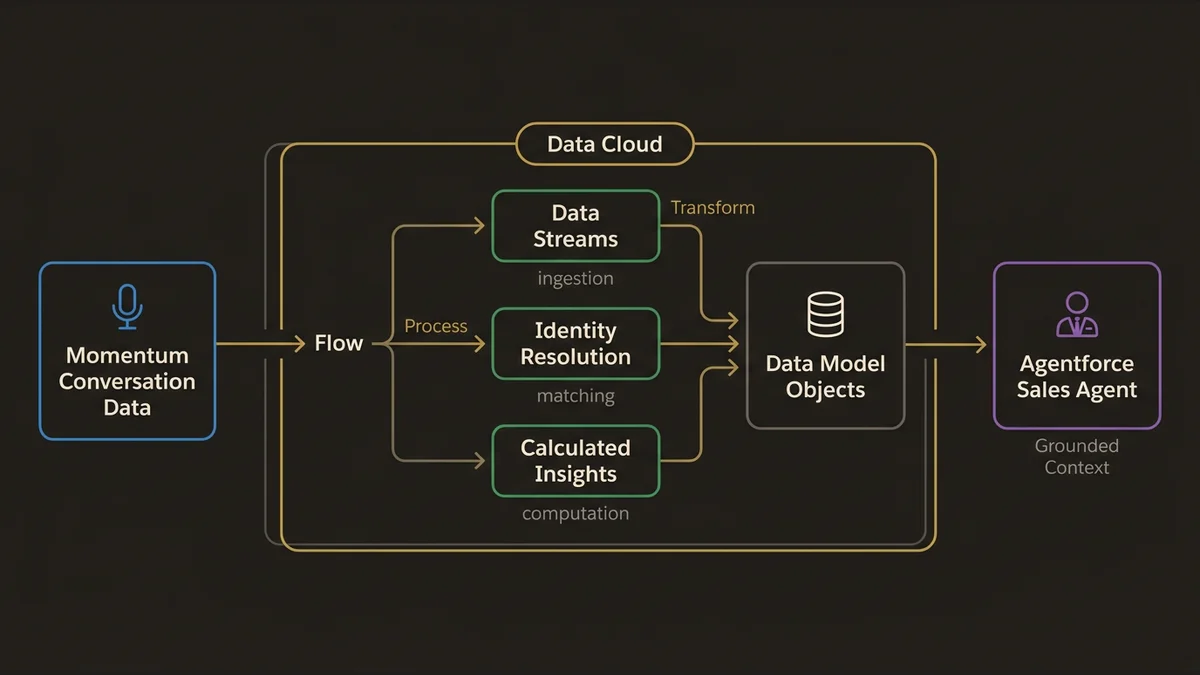
Momentum’s conversation data needs to be unified with CRM records, email activity, and opportunity history to produce meaningful signal. That unification work is Data Cloud’s job: Data Streams ingest the conversation records, Identity Resolution ties them to the correct Account and Contact, and Calculated Insights compute the derived metrics (sentiment trend, engagement depth, risk indicators) at the profile level.
Once those Calculated Insights exist as Data Model Objects in Data Cloud, they become available to Agentforce as grounded context. An Agentforce Sales Agent can surface deal risk before a forecast call, not because a rep flagged it, but because the conversation pattern over the last three weeks matches the signature of deals that historically stalled at this stage.
That’s a materially different capability than what Gong offers. Gong surfaces insight inside Gong. Salesforce’s play is to surface insight inside the workflow where the rep already operates; inside the CRM, inside the forecast, inside the next-step recommendation from an Agentforce agent. The integration depth is the competitive advantage, if Salesforce executes it.
Where Gong and Chorus Are Actually Vulnerable
Gong’s weakness isn’t the AI. It’s the integration tax. Every insight Gong surfaces requires a rep to context-switch: leave Salesforce, open Gong, review the call summary, return to Salesforce, update the record. In practice, most reps don’t complete that loop consistently. The insight exists in Gong; the CRM stays stale.
Chorus has the same problem, compounded by the Zoom acquisition creating strategic uncertainty about product investment priorities.
The orgs most vulnerable to displacement are those running Gong as a standalone tool with a shallow Salesforce integration; call recordings synced to Activity records, maybe a Gong widget embedded in the opportunity layout. That’s not deep integration. That’s a data pipe with a UI wrapper. Salesforce can replicate that surface area while offering something Gong structurally cannot: native platform depth.
Where Gong is harder to displace is in orgs that have built their coaching culture around Gong’s interface. Sales managers who run weekly call reviews inside Gong, who have built scorecards and coaching workflows there, have switching costs that aren’t technical. They’re behavioral. Salesforce will need a credible coaching UI to compete in that motion, and that’s not something Momentum provides out of the box.
The Einstein Positioning Problem This Solves
Einstein has carried a credibility problem in the revenue intelligence space for three reasons.
First, the data quality dependency. Einstein’s recommendations are only as good as the CRM data underneath them. In most enterprise orgs, CRM data quality is poor: incomplete contact records, inconsistent stage hygiene, activity logging that reflects what reps want managers to see rather than what’s actually happening. Einstein scoring on top of bad data produces bad scores, and sales teams learn to ignore them.
Second, the lagging signal problem described above. Einstein sees the deal after the rep has touched it. Momentum sees the deal as it’s happening.
Third, the trust gap. Reps don’t trust AI recommendations that feel disconnected from their actual conversations. “Einstein says this deal is at risk” lands differently than “the last three calls showed the economic buyer stopped engaging and the champion’s language shifted from ‘when we implement’ to ‘if we move forward.’” The second version is grounded in observable behavior. Reps can verify it. That verifiability is what builds adoption.
Momentum’s conversation intelligence addresses all three. It adds a leading signal source that doesn’t depend on rep logging discipline. It grounds recommendations in observable conversation behavior rather than CRM field values. And it gives Einstein a credibility anchor that the platform has been missing.
What Enterprise Buyers Should Evaluate Now
The acquisition is recent. The integration roadmap is not fully public. Enterprise buyers evaluating revenue intelligence platforms in 2026 are making decisions before the Momentum-Einstein integration reaches production maturity. That creates a specific evaluation risk.
Orgs that sign multi-year Gong contracts now are betting that Salesforce’s integration will either not materialize or not be competitive by renewal time. That’s a defensible bet if the org has deep Gong adoption and a coaching culture built around it. The switching cost is real.
Orgs that are currently evaluating Gong for the first time, or running Chorus on an expiring contract, are in a different position. The calculus there is whether to commit to a best-of-breed tool that will require ongoing integration maintenance, or to wait 12-18 months for Salesforce’s native capability to mature. For orgs already running Sales Cloud, Service Cloud, and Data Cloud, the platform consolidation argument is strong.
The specific questions worth asking Salesforce in any evaluation:
- Where does Momentum’s conversation data land in the data model; Activity records, Data Cloud DMOs, or both?
- What is the roadmap for surfacing Momentum insights inside Agentforce agent actions, not just Einstein dashboards?
- How does Identity Resolution handle conversation participants who aren’t in the CRM as Contacts?
- What is the coaching workflow story, and when does it reach feature parity with Gong’s review interface?
If Salesforce can’t answer the third question specifically, the integration isn’t ready for enterprise scale. Identity resolution across conversation participants is a harder problem than it looks, particularly in complex B2B deals with multiple stakeholders across multiple calls.
The Competitive Outcome That’s Most Likely
Salesforce won’t displace Gong in accounts where Gong is deeply embedded. That’s not the target. The target is greenfield revenue intelligence deployments and Chorus replacements, where the integration tax of a standalone tool is a live objection and the platform consolidation argument has budget support.
In those accounts, the Salesforce pitch becomes coherent in a way it wasn’t before Momentum: one platform, one data model, conversation intelligence that feeds directly into Agentforce agents and Einstein forecasting without a separate integration layer to maintain.
That’s a real competitive position. It’s not a guaranteed win, but it’s a structurally sound one. The execution risk is timeline. If Salesforce takes 24 months to deliver a production-ready integration, Gong has time to deepen its own Salesforce integration and close the workflow gap from the other direction.
The current decision for enterprise buyers determines whether they’re locked into a best-of-breed stack that requires ongoing integration investment, or positioned to consolidate onto a platform that may deliver native parity within 18 months.
If you’re evaluating revenue intelligence for the first time on Sales Cloud, wait 12 to 18 months and negotiate a short-term Momentum pilot rather than committing to a multi-year Gong contract. The platform consolidation argument has time to mature, and the integration tax on a standalone tool is structurally unfavorable from here. That’s the call.
Key Takeaways
- Behavioral signal and coaching workflow are Gong’s moat, not transcription. Compete on both or don’t compete.
- Run Momentum through Data Cloud and Agentforce, not Einstein standalone. Conversation data becomes Calculated Insights; agents read those, not raw transcripts.
- Lagging CRM signal and data quality dependency. Two structural reasons Einstein loses credibility in revenue intelligence today.
- First-time evaluators face a real consolidation argument; orgs deep in Gong face behavioral switching costs. Different decisions for different starting points.
- Identity Resolution across conversation participants is the integration question that decides everything. No clean answer means not ready for enterprise scale.
Need help with ai & agentforce architecture?
Design and implement Salesforce Agentforce agents, Prompt Builder templates, and AI-powered automation across Sales, Service, and Experience Cloud.
Related Articles

Agentforce Operations: Architecture Guide
Agentforce Operations redefines back-office automation. Here's the architectural blueprint for deterministic agent control planes at enterprise scale.

Salesforce Prompt Builder : bonnes pratiques
Prompt Builder mal configuré = agents Agentforce imprévisibles. Les bonnes pratiques architecturales pour éviter les pièges les plus coûteux.

Salesforce AI Specialist Cert Prep 2026
The Salesforce AI Specialist certification in 2026 tests architecture judgment, not recall. Here's how to prepare for what the exam actually measures.