
Agentforce Contact Center is not a feature release. It’s a structural argument that third-party CCaaS integrations are the wrong layer to own customer context. If your Service Cloud architecture still routes through an external contact center platform as the system of record, that assumption just became expensive to defend.
The architectural implications run deeper than most initial assessments suggest. This isn’t about replacing a telephony vendor. It’s about where conversation state, AI reasoning, and agent context actually live, and whether your current data model can support the shift.
Why Native CRM Unification Changes the Data Flow Problem
The dominant pattern in enterprise service architectures has been a CCaaS platform sitting between the customer and Salesforce, with CTI adapters and screen pops providing a thin integration layer. The contact center owns the conversation. Salesforce owns the record. The two sync imperfectly, usually through event-driven middleware or scheduled batch jobs.
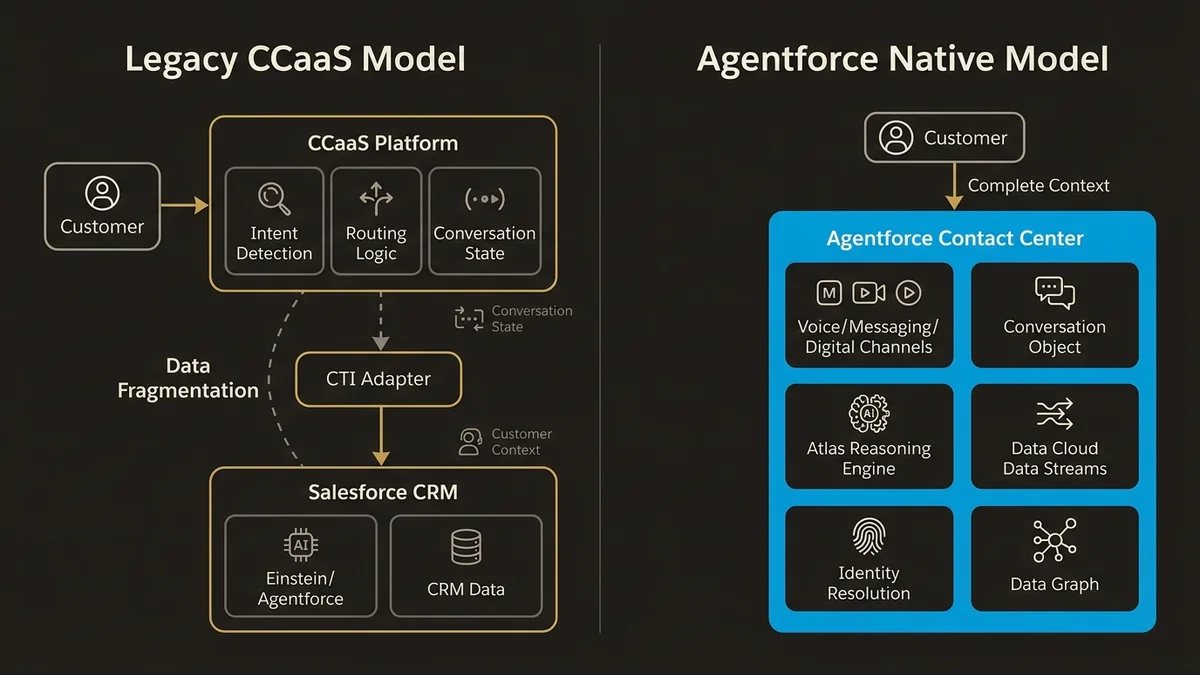
That model has a structural flaw: the AI reasoning layer ends up split. The CCaaS platform runs its own intent detection and routing logic. Salesforce runs Einstein or Agentforce on CRM data. Neither system has full context at the moment it matters, which is during the live interaction.
Agentforce Contact Center collapses this by making the conversation itself a first-class Salesforce object. Voice, messaging, and digital channels feed directly into Data Cloud Data Streams. Identity Resolution rulesets run against the incoming contact to resolve the Unified Individual before the interaction reaches a human or an AI agent. By the time the Atlas Reasoning Engine is invoked, it has access to the full Data Graph, not a screen pop with three fields from a CTI lookup.
In practice, this means the AI handoff decision is made with complete customer context rather than session-scoped context. That’s a qualitatively different capability, not an incremental improvement.
Evaluating Your Data Flow Redesign Before You Migrate
The architectural shift sounds clean in principle. The migration path is not. Before committing to Agentforce Contact Center as the primary channel layer, three data flow questions need honest answers.
First, where does your current contact center data actually live? In most enterprise deployments, conversation transcripts, sentiment scores, CSAT results, and interaction metadata are stored in the CCaaS platform’s proprietary data model. Migrating that history into Data Cloud requires building Data Streams from the legacy system, mapping to Data Model Objects, and running Identity Resolution against historical records that may have been created without a consistent customer identifier. At scale, this is a multi-month data engineering effort, not a configuration task.
Second, what does your real-time routing logic depend on? CCaaS platforms accumulate years of routing rules, skill-based assignment logic, and queue configurations. Some of that logic is reproducible in Flow orchestration and Agentforce Topics and Actions. Some of it depends on real-time workforce management signals that Salesforce doesn’t natively expose. Identifying those dependencies early determines whether you’re doing a clean migration or a hybrid architecture that keeps the CCaaS platform for routing while Salesforce owns the AI layer.
Third, how are your SLAs defined? If your contact center SLAs are measured inside the CCaaS platform’s reporting infrastructure, migrating to native Salesforce means rebuilding that reporting in CRM Analytics. That’s not a blocker, but it’s a scope item that gets underestimated consistently.
For orgs running 500+ concurrent agents across multiple channels, the data flow redesign is typically a 90-day parallel-run exercise before any cutover. Treating it as a lift-and-shift will produce a broken architecture.
AI-Human Handoff Protocols That Actually Work
The handoff problem is where most Agentforce Contact Center implementations will succeed or fail. The Atlas Reasoning Engine can handle a significant percentage of tier-one service interactions autonomously. The question is what happens at the boundary.
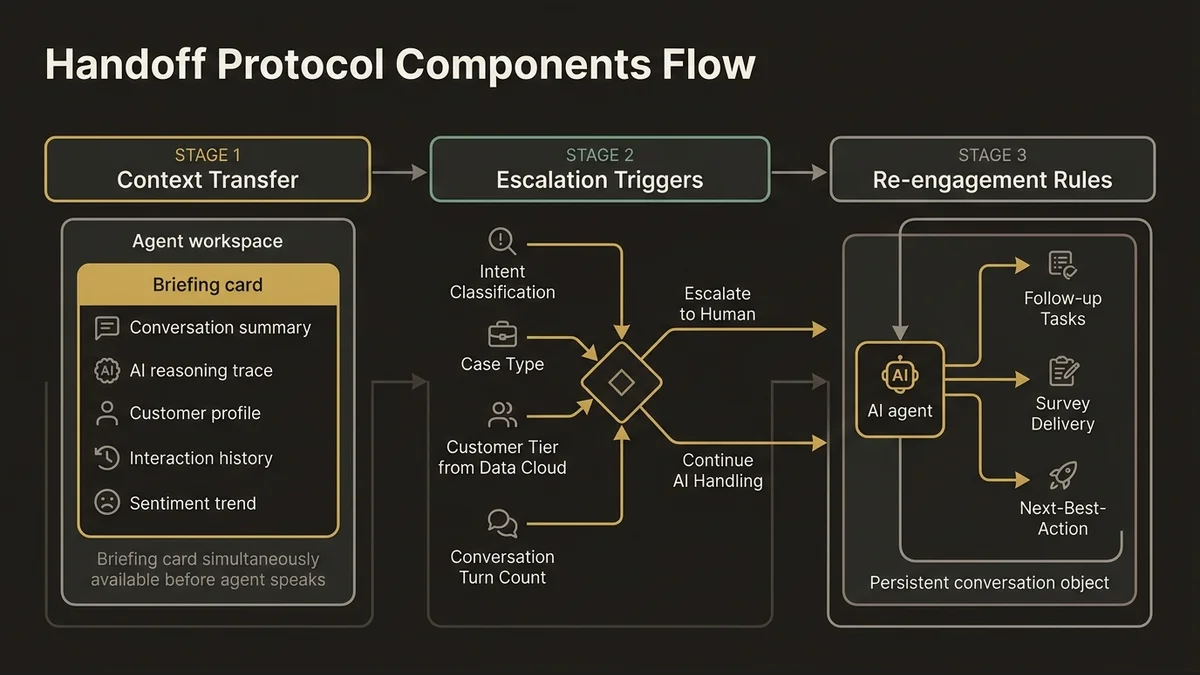
A well-designed handoff protocol has three components: context transfer, escalation triggers, and re-engagement rules.
Context transfer means the human agent receives the full conversation summary, the AI’s reasoning trace, and the customer’s unified profile at the moment of handoff, not after a 30-second screen load. Agentforce supports this through Prompt Builder Flex templates that generate structured handoff summaries from the conversation transcript and Data Cloud Calculated Insights. The template pulls the customer’s interaction history, open cases, and sentiment trend into a single briefing that appears in the agent’s workspace before they say hello.
Escalation triggers need to be defined at the Topic level in Agentforce configuration. The common mistake is defining escalation purely on sentiment signals, which produces false positives. A frustrated customer asking a simple billing question doesn’t need a human. A calm customer asking about a regulatory complaint does. Effective trigger logic combines intent classification, case type, customer tier from Data Cloud Segments, and conversation turn count. That combination is more reliable than sentiment alone.
Re-engagement rules govern what happens after a human resolves the interaction. In a native architecture, the AI agent can be re-engaged for follow-up tasks, survey delivery, or next-best-action recommendations without requiring the customer to restart a session. This is only possible because the conversation object persists in Salesforce with full state. In a CCaaS-integrated model, the session typically closes on transfer and that continuity is lost.
The orgs that get handoff right treat it as a protocol design problem, not a configuration problem. The decisions about what triggers escalation, what context transfers, and what the AI does post-resolution need to be made by architects and service operations leaders together, before anyone touches the Agentforce Testing Center.
Multi-Channel Scaling Patterns for Service Cloud Enterprises
Agentforce Contact Center’s multi-channel architecture is built on a unified conversation model, but scaling it across voice, chat, email, and social requires deliberate channel-specific design.
Voice is the highest-stakes channel and the one with the most integration complexity. Native voice in Salesforce runs through Amazon Connect under the hood for most deployments. The architectural implication is that your telephony infrastructure decisions are now coupled to your AWS region choices, which affects data residency for orgs with GDPR or data sovereignty requirements. This is not a theoretical concern. It’s a deployment decision that needs legal and compliance sign-off before architecture finalization.
Messaging channels, including WhatsApp, SMS, and in-app chat, are where Agentforce Contact Center’s autonomous handling is strongest. The latency profile for AI-driven messaging interactions is well within acceptable bounds for asynchronous channels. The scaling pattern that works here is to deploy Agentforce as the first-touch handler for all inbound messaging, with human agents handling only escalated conversations. At this configuration, orgs with high messaging volume can achieve meaningful deflection rates without degrading customer experience, provided the escalation triggers are well-tuned.
Email is the channel most likely to be underestimated. High-volume service email requires classification, routing, and response generation at scale. Agentforce can handle classification and draft generation through Prompt Builder Field Generation templates, but the workflow orchestration to move emails through triage, draft review, and send requires careful Flow design. The temptation to automate email responses fully without a human review step is one to resist until the AI’s accuracy on your specific case taxonomy is validated through the Agentforce Testing Center.
For enterprises running omnichannel service at scale, the right architecture is not to treat all channels identically. Voice, messaging, and email have different latency tolerances, different AI accuracy profiles, and different regulatory considerations. A channel-differentiated deployment strategy, where each channel has its own escalation logic and AI autonomy level, outperforms a uniform configuration every time.
You can see how this channel-differentiated thinking connects to broader multi-cloud integration design patterns that govern how Salesforce interacts with external systems at the edges of a native architecture.
If you’re evaluating whether to consolidate on Agentforce Contact Center or maintain a hybrid CCaaS model, the architectural assessment framework at /services/agentforce-architecture covers the decision criteria in detail.
What Most Enterprises Get Wrong in the First 90 Days
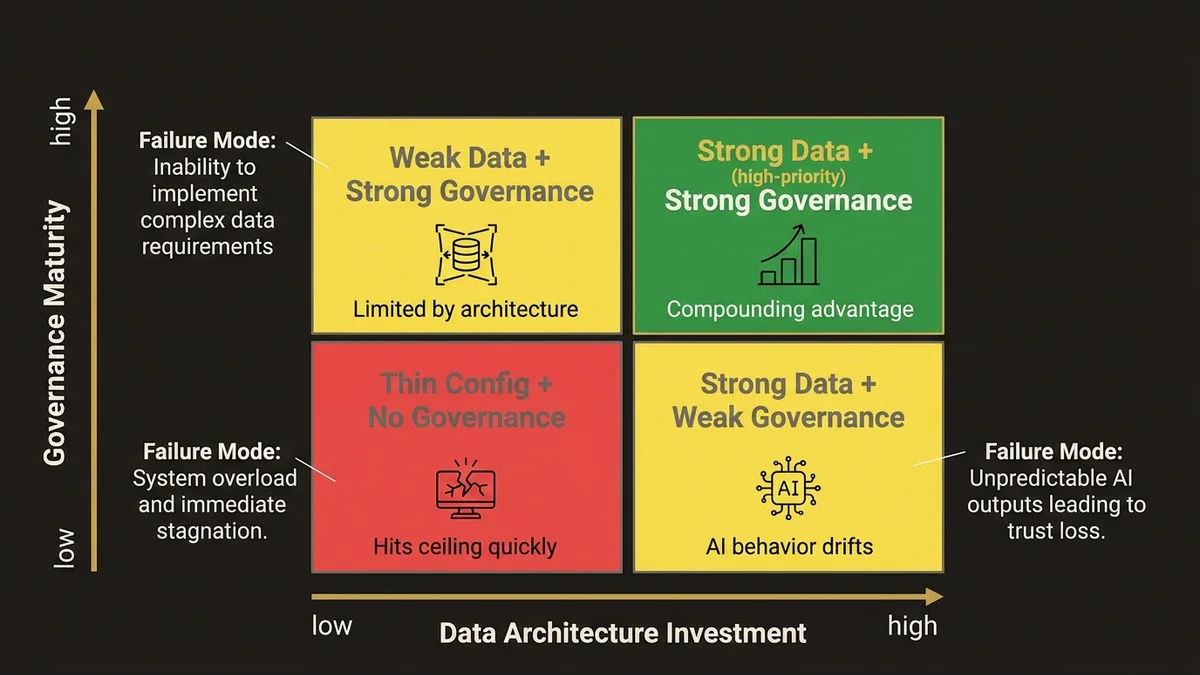
The most common failure mode is treating Agentforce Contact Center as a CCaaS replacement project rather than a CRM architecture project. The procurement decision gets made in IT or operations. The implementation gets handed to a Salesforce admin team. The data architecture work, the identity resolution configuration, the Data Graph design, the Prompt Builder template governance, none of that gets resourced appropriately because it wasn’t scoped as part of the project.
The second failure mode is underinvesting in the Agentforce Testing Center before go-live. The Testing Center allows you to run simulated conversations against your Topics and Actions configuration and validate that escalation triggers fire correctly. Orgs that skip structured testing and go straight to pilot with live customers discover their escalation logic in production, which is a poor way to learn.
The third failure mode is not establishing a governance model for AI behavior before deployment. Agentforce Instructions define how the AI agent behaves within a Topic. Those instructions need to be owned by someone, reviewed regularly, and updated as your service policies change. Without a governance process, the AI’s behavior drifts from your actual service standards over time.
The forward-looking reality is this: the orgs that invest in the data architecture and governance work now will have a compounding advantage as Agentforce capabilities expand. The ones that deploy a thin configuration on top of an unreformed data model will hit a ceiling quickly and face a more expensive remediation later.
Key Takeaways
- Agentforce Contact Center moves conversation state into Salesforce as a first-class object, which enables the Atlas Reasoning Engine to reason against the full Data Graph rather than session-scoped CCaaS data. This is a structural capability difference, not a feature increment.
- Data flow redesign is the critical path item. Migrating historical interaction data from CCaaS platforms into Data Cloud Data Streams and resolving identities against Unified Individuals is a multi-month effort at enterprise scale, not a configuration task.
- Effective AI-human handoff requires protocol design across three dimensions: context transfer via Prompt Builder Flex templates, escalation triggers combining intent, case type, and customer tier, and re-engagement rules that preserve conversation continuity post-resolution.
- Multi-channel scaling requires channel-differentiated AI autonomy levels. Voice, messaging, and email have different latency tolerances and accuracy profiles. A uniform configuration across all channels underperforms a channel-specific deployment strategy.
- The governance model for Agentforce Instructions needs to be established before go-live. AI behavior that isn’t actively governed drifts from service standards, and correcting that drift in production is more costly than preventing it through structured review cycles.
Need help with ai & agentforce architecture?
Design and implement Salesforce Agentforce agents, Prompt Builder templates, and AI-powered automation across Sales, Service, and Experience Cloud.
Related Articles

Agentforce Operations: Architecture Guide
Agentforce Operations redefines back-office automation. Here's the architectural blueprint for deterministic agent control planes at enterprise scale.

Salesforce Prompt Builder : bonnes pratiques
Prompt Builder mal configuré = agents Agentforce imprévisibles. Les bonnes pratiques architecturales pour éviter les pièges les plus coûteux.

Salesforce AI Specialist Cert Prep 2026
The Salesforce AI Specialist certification in 2026 tests architecture judgment, not recall. Here's how to prepare for what the exam actually measures.