
Most candidates approaching salesforce ai specialist certification prep 2026 treat it like a memorization exercise. They’re wrong, and the exam will punish them for it. The AI Specialist credential is fundamentally a test of architectural judgment under ambiguity, not a vocabulary quiz about feature names.
That distinction matters because the study approach that works for Administrator or Platform Developer certifications actively fails here. Flashcards on Einstein feature lists won’t get you to a passing score. What will is understanding how the components interact under real constraints, and being able to reason about tradeoffs when the scenario doesn’t have an obvious answer.
What the Exam Actually Tests
The AI Specialist exam is organized around Agentforce, Prompt Builder, and Einstein generative features, but the questions are scenario-driven. You’re not asked “what is the Atlas Reasoning Engine?” You’re asked which configuration choice produces a specific outcome given a set of business constraints.
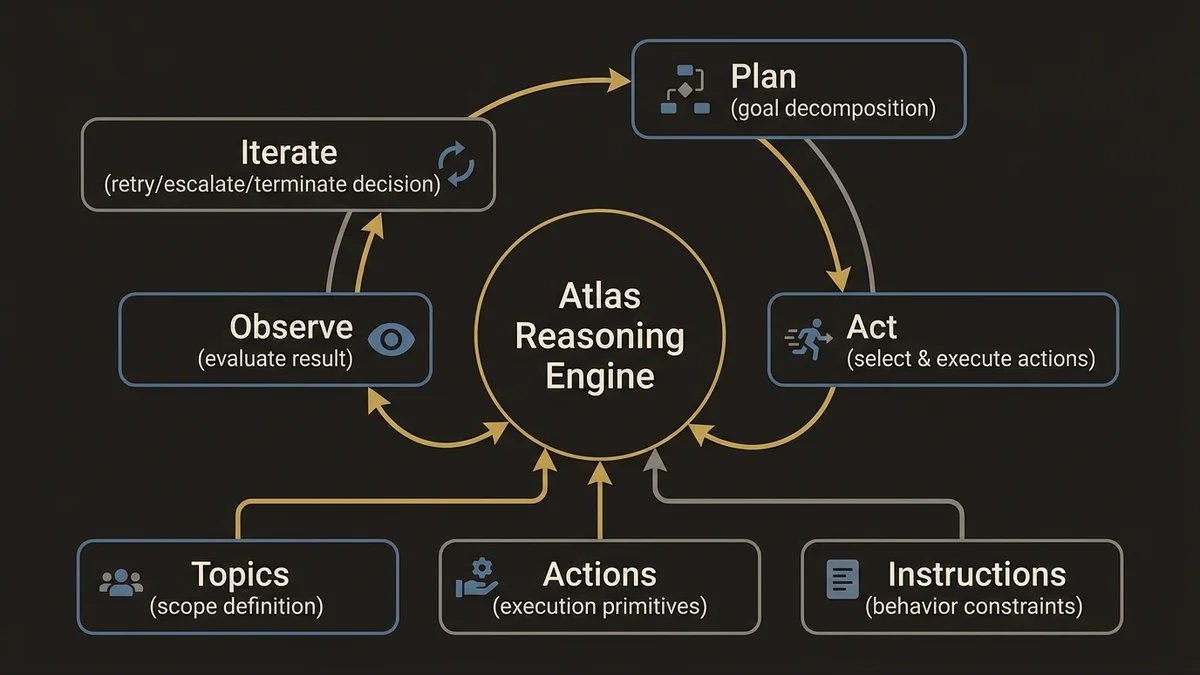
The Atlas Reasoning Engine is worth understanding deeply, not as a definition but as a reasoning model. It operates through a plan-act-observe loop: the agent decomposes a goal into steps, selects Actions, executes them, evaluates the result, and iterates. The exam tests whether you understand when that loop breaks. If an Action returns ambiguous output, does the agent retry, escalate, or terminate? The answer depends on how Topics and Instructions are configured, and the exam will put you in scenarios where you have to distinguish between those outcomes.
Prompt Builder is the other high-weight domain. The three template types, Sales Email, Field Generation, and Flex, are not interchangeable. Field Generation templates run in a record context and write back to a specific field. Flex templates are invoked programmatically and have no native record binding. The exam will present scenarios where a candidate might reach for the wrong template type, and you need to recognize the mismatch immediately.
Grounding is tested heavily. The difference between static grounding (data merged into a prompt template at generation time) and dynamic grounding (Data Cloud Calculated Insights or Data Graphs surfaced at runtime) is architecturally significant. Static grounding is simpler but stale. Dynamic grounding is fresher but introduces latency and requires Data Cloud to be provisioned and connected. Exam scenarios will describe a business requirement and ask which grounding approach is appropriate. If the requirement mentions real-time personalization at scale, dynamic grounding via Data Cloud is the answer. If it’s a templated outreach with predictable data, static is fine.
The Data Cloud Dependency Most Candidates Underestimate
A significant portion of the AI Specialist exam assumes Data Cloud literacy. This catches candidates who studied Agentforce in isolation.
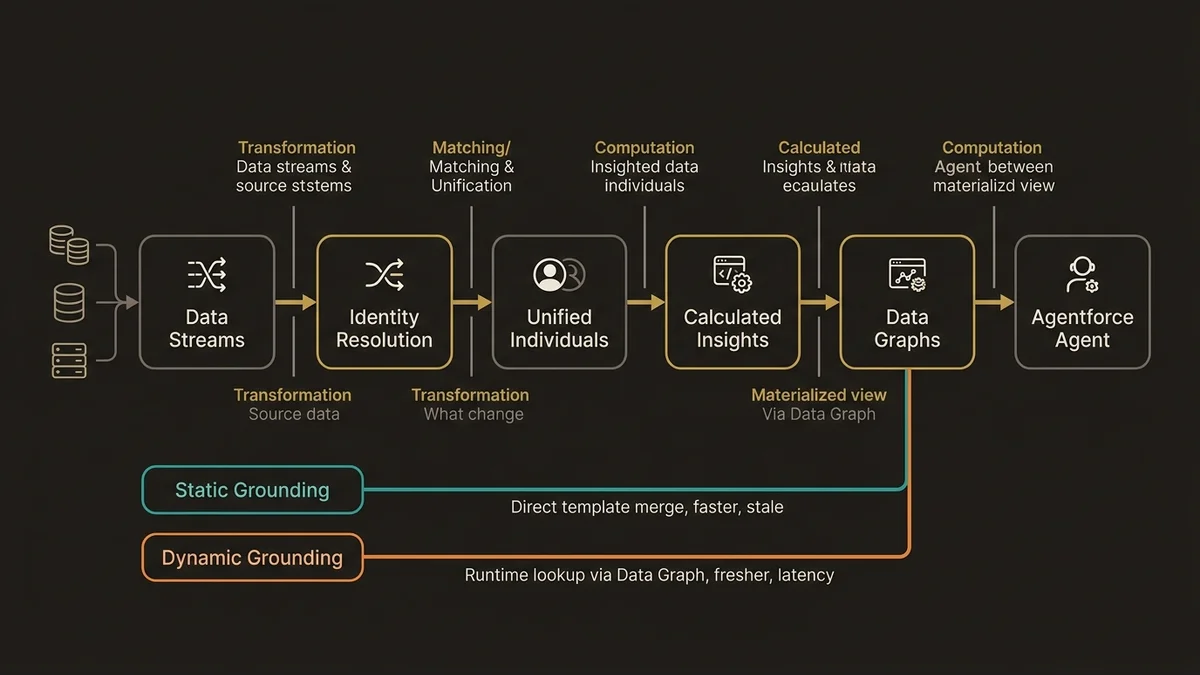
Identity Resolution is the foundation. The exam expects you to understand that Unified Individuals are the output of matching rulesets applied across Data Streams, and that Agentforce agents operating on customer context are consuming that unified profile, not raw CRM records. If Identity Resolution is misconfigured or hasn’t run, the agent’s grounding is incomplete. That’s not a Data Cloud problem in isolation; it’s an Agentforce reliability problem.
Calculated Insights are the mechanism for surfacing computed metrics into prompts. If a scenario describes an agent that needs to reference a customer’s lifetime value or churn probability, the architecture requires a Calculated Insight defined in Data Cloud, surfaced through a Data Graph, and referenced in the Prompt Builder template. Candidates who don’t know this chain will pick answers that describe pulling data through Apex or Flow, which is technically possible but architecturally wrong for this use case.
Data Graphs deserve specific attention. They’re materialized views that pre-compute joins across Data Model Objects, and they exist specifically to reduce query latency at agent runtime. The exam will test whether you know when to use a Data Graph versus a direct DMO query. At scale, anything requiring sub-second response in an agent interaction should be backed by a Data Graph. Direct DMO queries are acceptable for batch processes or low-frequency lookups.
For a deeper treatment of how Data Cloud and Agentforce interact architecturally, the Salesforce AI architecture for enterprise retail article covers the integration patterns in detail.
Where Candidates Lose Points: Prompt Engineering and Trust Layer
The Trust Layer section of the exam is underweighted in most study guides and overweighted in the actual exam. Einstein Trust Layer is not just a compliance checkbox. It’s an architectural component with specific behaviors: data masking before prompts leave Salesforce infrastructure, toxicity detection on outputs, audit logging through the Prompt Audit Trail.
The exam will test whether you understand what the Trust Layer does and does not protect. It masks PII in prompts sent to the LLM. It does not prevent a poorly written Flex template from exposing sensitive data in its output if the template itself concatenates unmasked fields before the masking layer runs. That’s a design error, not a Trust Layer failure, and the exam distinguishes between them.
Prompt injection is another tested concept. The scenario will describe a customer-facing agent where user input is incorporated into a prompt, and ask which configuration mitigates injection risk. The answer involves constraining the agent’s Topics scope and using Instructions to reject out-of-scope inputs, not relying on the Trust Layer alone.
On prompt engineering mechanics: the exam tests token efficiency and instruction clarity. A Prompt Builder template that includes redundant context, contradictory instructions, or unbounded output length will produce inconsistent results. The exam will present two template designs and ask which one is more likely to produce reliable, structured output. The answer is always the one with tighter scope, explicit output format instructions, and no conflicting directives.
How to Structure Your Preparation
Six weeks is the right preparation window for candidates with existing Salesforce architecture experience. Less than that and you’re rushing the conceptual work. More than that and you’re over-indexing on memorization.
Weeks one and two should be entirely conceptual. Work through the Atlas Reasoning Engine’s plan-act-observe loop until you can trace it through a multi-step scenario without referring to notes. Understand how Topics define agent scope, how Actions are the execution primitives, and how Instructions constrain behavior. Don’t touch practice questions yet.
Weeks three and four: Prompt Builder and Data Cloud grounding. Build actual templates in a developer org. The difference between Field Generation and Flex templates is much clearer after you’ve misconfigured one and watched it fail. Set up a basic Data Cloud connection, create a Calculated Insight, and surface it in a prompt. The hands-on work encodes the architecture in a way that reading doesn’t.
Week five: Trust Layer, security model, and edge cases. This is where you work through scenarios involving data masking, audit trails, and agent escalation paths. The Agentforce Testing Center is worth understanding here, both as a tool and as an exam topic. It’s the mechanism for validating agent behavior against expected outputs before deployment.
Week six: practice exams under timed conditions, then targeted remediation. Don’t take practice exams earlier. Taking them before you’ve built the conceptual foundation just trains you to guess at answers you don’t understand, which is worse than not practicing at all.
For candidates coming from a consulting background who want to understand how this certification maps to real delivery work, why Salesforce architects must learn Agentforce frames the professional stakes clearly.
The Architectural Positions the Exam Rewards
The exam has a point of view, and it’s worth knowing what it is. Salesforce’s preferred architecture for AI features is: Data Cloud as the unified data layer, Prompt Builder as the template and grounding layer, Agentforce as the orchestration layer, and the Trust Layer as the governance layer. Answers that fit this stack are almost always correct. Answers that route around it, using Apex to call external LLMs directly, bypassing Data Cloud with SOQL queries in prompts, or building custom orchestration outside Flow, are almost always wrong even if they’re technically feasible.
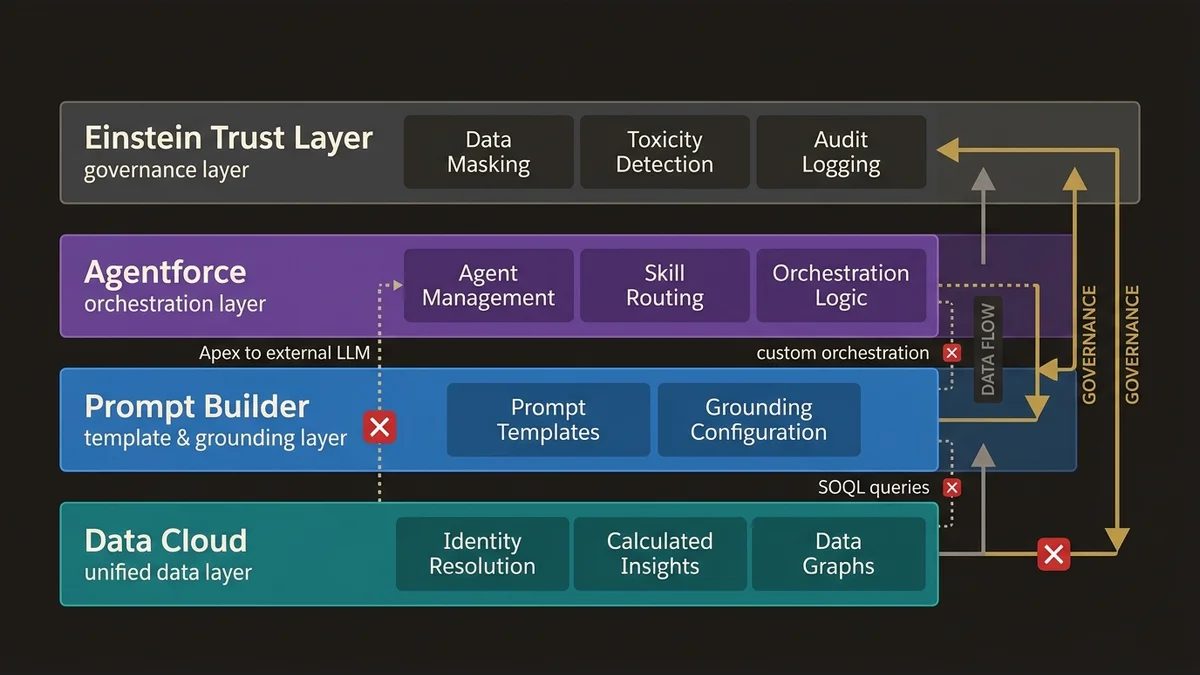
This isn’t about Salesforce being parochial. The preferred stack exists because it’s the only configuration where the Trust Layer, audit logging, and Identity Resolution guarantees are fully intact. An architecture that bypasses Data Cloud for grounding might work in a demo but loses the unified profile guarantees. The exam rewards candidates who understand why the stack is designed the way it is, not just what the components are.
The practical implication for preparation: when you encounter a scenario where a creative workaround seems appealing, ask yourself whether it preserves the full Trust Layer and Data Cloud grounding chain. If it doesn’t, it’s probably the wrong answer.
For organizations evaluating whether to invest in AI Specialist-certified architects for Agentforce delivery, the Agentforce architecture service page covers what that architectural depth looks like in practice.
Key Takeaways
- The AI Specialist exam tests architectural reasoning under scenario constraints, not feature recall. Candidates who study for memorization will underperform.
- Atlas Reasoning Engine’s plan-act-observe loop is the conceptual core of the Agentforce domain. Understanding when and why it fails is more important than knowing what it is.
- Data Cloud literacy is non-negotiable. Calculated Insights, Data Graphs, and Identity Resolution are tested as dependencies of Agentforce grounding, not as standalone Data Cloud topics.
- The Einstein Trust Layer is an architectural component with specific behaviors and specific gaps. The exam distinguishes between Trust Layer failures and design errors in prompt templates.
- Salesforce’s preferred AI stack (Data Cloud + Prompt Builder + Agentforce + Trust Layer) is the answer pattern the exam rewards. Architectures that route around any layer of that stack are almost always wrong in exam scenarios, regardless of technical feasibility.
Need help with ai & agentforce architecture?
Design and implement Salesforce Agentforce agents, Prompt Builder templates, and AI-powered automation across Sales, Service, and Experience Cloud.
Related Articles

Agentforce vs Einstein Bots: Migration Path
Einstein Bots are end-of-life. Here's the architectural migration path to Agentforce that avoids the most common data and logic traps.

Agentforce Service Cloud : déflexion de cas réelle
Agentforce Service Cloud deflection cas : comment architecturer une déflexion qui tient en production, sans sacrifier la qualité de service.

ESN Agentforce : restructurer l'offre de services
Agentforce 360 GA force les ESN françaises à repenser leur modèle économique. Voici comment repositionner l'offre avant que le marché ne le fasse à votr...