
The architects who treat Agentforce as a feature to learn later are making a career-limiting bet. Why Salesforce architects should learn Agentforce now is not a motivational question; it is an architectural one. The platform’s reasoning layer has fundamentally changed what “solution design” means, and the gap between architects who understand it and those who don’t is already visible in how projects are scoped, staffed, and priced.
This is not about chasing a product cycle. It is about recognizing when a platform shift changes the underlying design vocabulary.
The Atlas Reasoning Engine Changes What Architects Design
For the past decade, Salesforce architecture has been largely deterministic. You model data, configure automation with Flow, expose APIs through External Services or MuleSoft, and wire it together with declarative logic. The mental model is a directed graph: inputs produce predictable outputs.
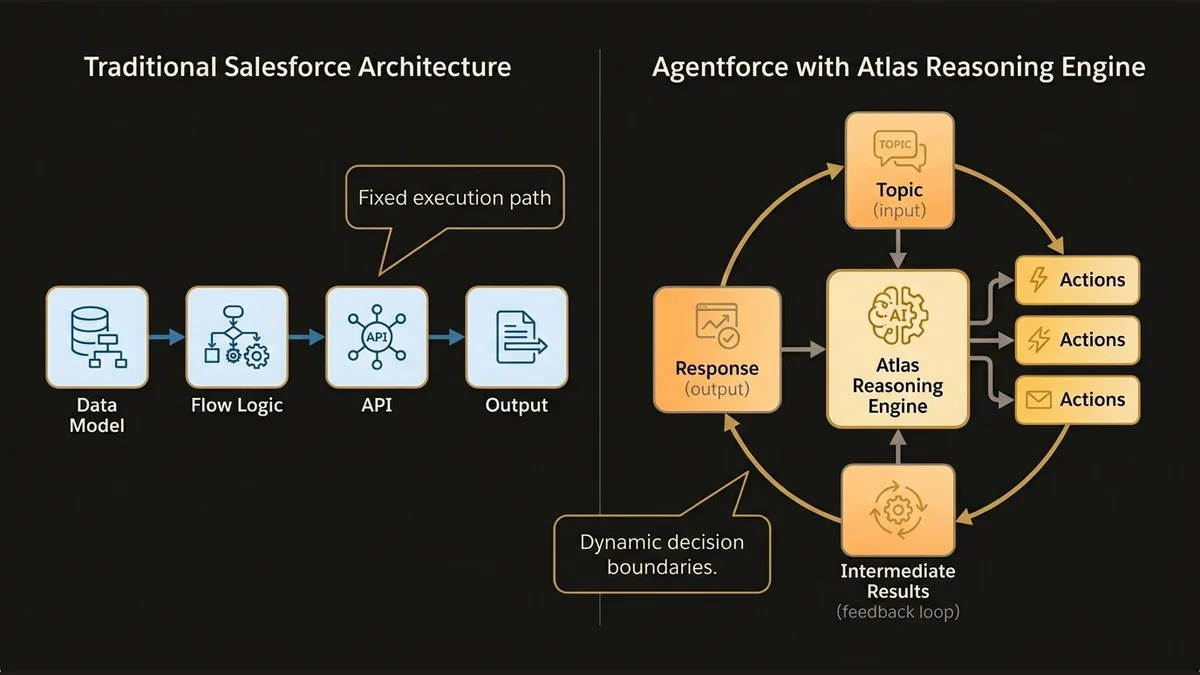
Agentforce’s Atlas Reasoning Engine breaks that model. The reasoning layer does not follow a fixed execution path. It interprets a Topic, selects from available Actions, evaluates intermediate results, and decides whether to invoke another Action or return a response. The architect’s job shifts from designing execution sequences to designing decision boundaries.
That is a different skill. Designing Topics and Instructions is closer to writing a policy document than configuring a workflow. You are defining the scope of autonomous behavior, not the steps of a process. Get the Instructions wrong and the agent either refuses valid requests or takes actions it should not. Neither failure mode is obvious in testing; they surface in production, at scale, in edge cases you did not anticipate.
Architects who have not internalized this shift will under-specify agent behavior and over-rely on the LLM to “figure it out.” That produces agents that work in demos and fail in enterprise deployments.
The Data Layer Dependency Is Non-Negotiable
Agentforce agents are only as useful as the context they can access. In practice, that means Data Cloud. An agent answering a customer service query needs unified profile data; purchase history, open cases, recent interactions, calculated loyalty metrics. Without a properly structured Data Graph feeding that context into the agent’s grounding layer, the agent hallucinates or gives generic responses that a basic Flow could have handled more reliably.
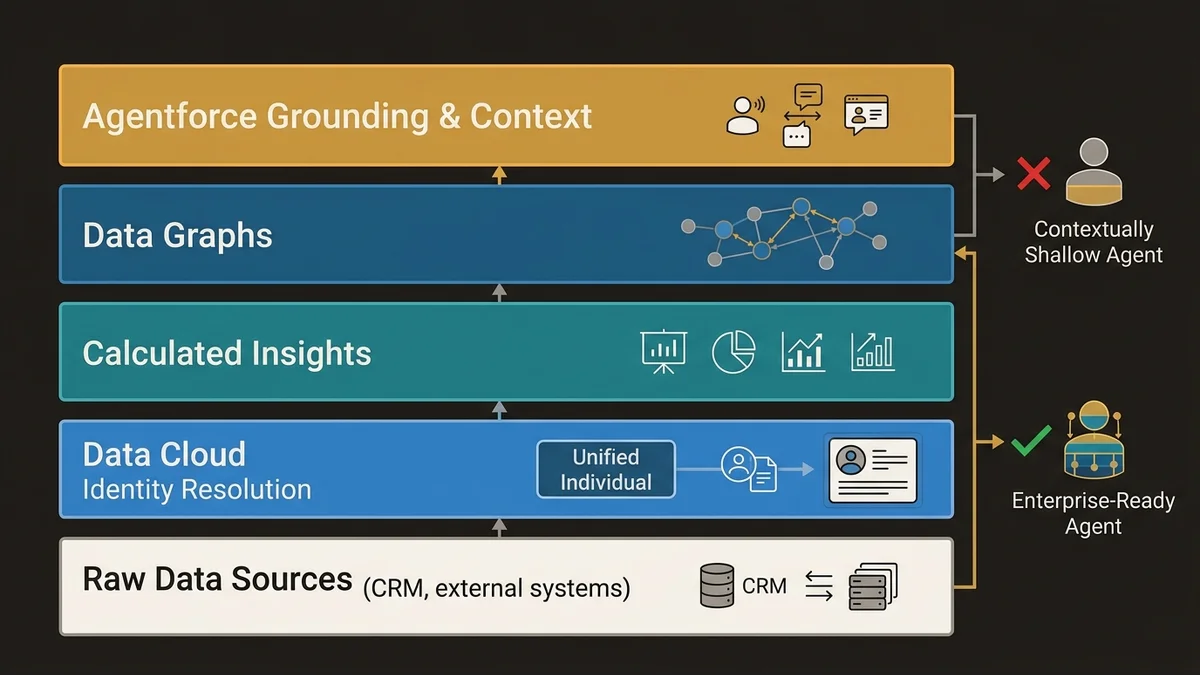
This is where architects who have avoided Data Cloud work get exposed. Understanding how Identity Resolution rulesets produce a Unified Individual, how Calculated Insights surface profile-level metrics, and how Data Graphs pre-compute joins for low-latency retrieval; these are not optional background knowledge. They are the foundation of any agent that does real work.
The architecture that works here is a tight coupling between Data Cloud’s activation layer and Agentforce’s grounding mechanism. Segments define which customers get which agent behavior. Calculated Insights give the agent the right numbers without requiring it to query raw data at runtime. Data Graphs reduce retrieval latency to a range where real-time interactions remain coherent.
Architects who understand only the CRM layer will design agents that are technically functional but contextually shallow. That is a significant limitation when the business case for Agentforce is almost always about personalization and contextual relevance.
For a deeper look at how Data Cloud’s identity layer feeds downstream AI use cases, the Data Cloud identity resolution architecture article covers the matching ruleset design in detail.
Prompt Builder Is Where Architecture Meets Governance
Most architects underestimate Prompt Builder. It looks like a template tool. It is actually the governance boundary between what the LLM can access and what it cannot.
Flex templates in Prompt Builder control which Data Cloud objects, CRM fields, and external data sources get merged into the prompt context. That merge operation is an architectural decision with security, compliance, and performance implications. Pulling a full account hierarchy into a prompt context for every agent invocation is expensive and potentially exposes data that should be scoped to specific roles. Designing lean, purposeful prompt templates requires the same judgment as designing a well-scoped API response.
In enterprise orgs with strict data residency requirements, the Prompt Builder template design is also where GDPR and data sovereignty constraints get enforced. If the architect does not own that design, it defaults to whoever built the first working prototype; which is rarely the right outcome.
There is also a testing dimension. The Agentforce Testing Center allows structured validation of agent behavior against defined scenarios, but the quality of that testing depends entirely on how well the architect has specified the expected behavior in Topics and Instructions. Vague Instructions produce inconsistent test results that give false confidence. Precise Instructions produce testable, auditable behavior.
The Skill Gap Is Already Pricing Into the Market
This is the forward-looking frame that matters most. The architects who understand Agentforce’s full stack; Atlas Reasoning Engine behavior, Data Cloud grounding, Prompt Builder governance, Flow orchestration as an Action layer; are commanding a different tier of engagement than those who understand only the CRM configuration layer.
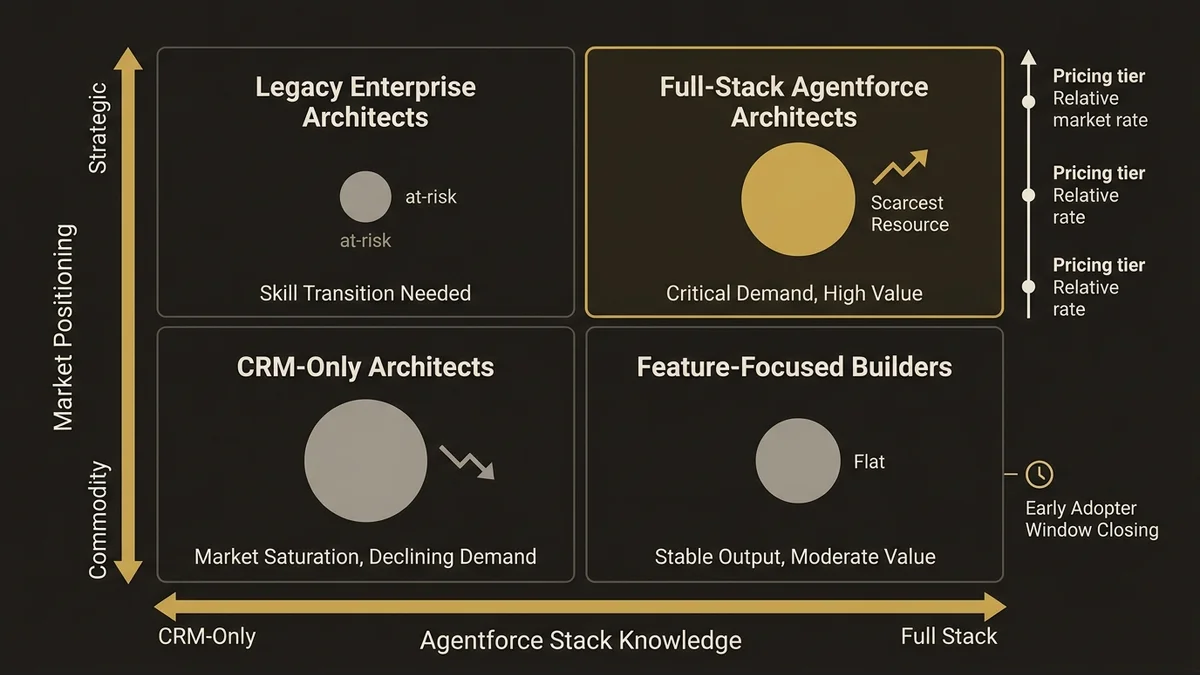
In enterprise orgs coordinating AI deployments across multiple business units, the scarcest resource is not budget or licenses. It is architects who can design agent behavior that is both technically sound and governable at scale. That means understanding how to scope Topics so agents do not drift into adjacent domains, how to design Actions that are idempotent and auditable, and how to structure the Data Cloud data model so agents have the context they need without accessing data they should not.
The architects who have not made this investment yet are not behind by a feature version. They are behind by a design paradigm. Catching up gets harder as the installed base of Agentforce deployments grows, because the patterns that emerge from early enterprise deployments become the reference architecture that everyone else is measured against.
A common pattern in enterprise orgs running large-scale Agentforce rollouts is that the first architect who designs a working, governed agent pattern becomes the de facto standard-setter for the entire program. That is a position worth occupying early.
The counterargument worth taking seriously is that Agentforce is still maturing and early investment carries platform risk. That is true. But the architectural concepts; reasoning under uncertainty, context grounding, behavior scoping, governance at the prompt layer; are not going away. They are the foundation of any agentic AI system, Salesforce or otherwise. Learning them now through Agentforce gives architects a transferable mental model, not just a product certification.
What to Actually Do in the Next 90 Days
The architects who move fastest here are not the ones who complete the most Trailhead modules. They are the ones who build something real and hit the failure modes.
The concrete path is this: stand up a sandbox Agentforce deployment with a non-trivial use case; case deflection, order status, or internal knowledge retrieval are all well-understood patterns. Connect it to at least one Data Cloud Data Stream so the agent has real profile context to work with. Design the Topics and Instructions with enough specificity that you can write test cases for them in the Agentforce Testing Center. Then deliberately break it; write Instructions that are ambiguous and observe how the Atlas Reasoning Engine interprets them.
That exercise teaches more about agent design than any documentation. The failure modes are where the architectural judgment lives.
For architects who want to understand the broader case deflection architecture before building, agentforce case deflection architecture covers the design patterns that work at enterprise scale.
The service design work that follows from this; scoping Topics correctly, designing Actions that are composable and auditable, building Prompt Builder templates that enforce data governance; is covered in detail at /services/agentforce-architecture, which outlines the architectural engagement model for enterprise Agentforce deployments.
Key Takeaways
- The Atlas Reasoning Engine requires a different design vocabulary. Architects must shift from designing execution sequences to designing decision boundaries; Topics, Instructions, and Action scope replace Flow logic as the primary design surface.
- Data Cloud grounding is not optional. Agents without properly structured Data Graphs and Calculated Insights produce contextually shallow responses that undermine the business case for Agentforce.
- Prompt Builder is a governance layer, not a template tool. Flex template design controls data access scope, compliance boundaries, and prompt efficiency; it requires the same rigor as API design.
- The skill gap is already pricing into the market. Architects who understand the full Agentforce stack are positioned differently in enterprise programs where governed, scalable agent design is the scarcest resource.
- The fastest path to competence is deliberate failure. Build a real deployment, connect real data, write specific Instructions, and use the Agentforce Testing Center to surface the edge cases where architectural judgment matters most.
Need help with ai & agentforce architecture?
Design and implement Salesforce Agentforce agents, Prompt Builder templates, and AI-powered automation across Sales, Service, and Experience Cloud.
Related Articles

Agentforce Operations: Architecture Guide
Agentforce Operations redefines back-office automation. Here's the architectural blueprint for deterministic agent control planes at enterprise scale.

Salesforce Prompt Builder : bonnes pratiques
Prompt Builder mal configuré = agents Agentforce imprévisibles. Les bonnes pratiques architecturales pour éviter les pièges les plus coûteux.

Salesforce AI Specialist Cert Prep 2026
The Salesforce AI Specialist certification in 2026 tests architecture judgment, not recall. Here's how to prepare for what the exam actually measures.