Salesforce Agentforce competitive positioning telco is not a product story. It’s a platform strategy story. And the distinction matters more than most architects realize when they’re evaluating whether to build, buy, or wait.
The launch of Agentforce Communications is Salesforce making a specific bet: that vertical AI depth, delivered on a unified data and CRM substrate, beats point solutions stitched together with integration glue. That bet is either brilliant or overreaching, depending on what you think the real competitive threat is.
The Actual Competitive Threat Salesforce Is Responding To
Most commentary frames Agentforce Communications as Salesforce competing with itself, extending Communications Cloud with AI capabilities. That’s the wrong frame.
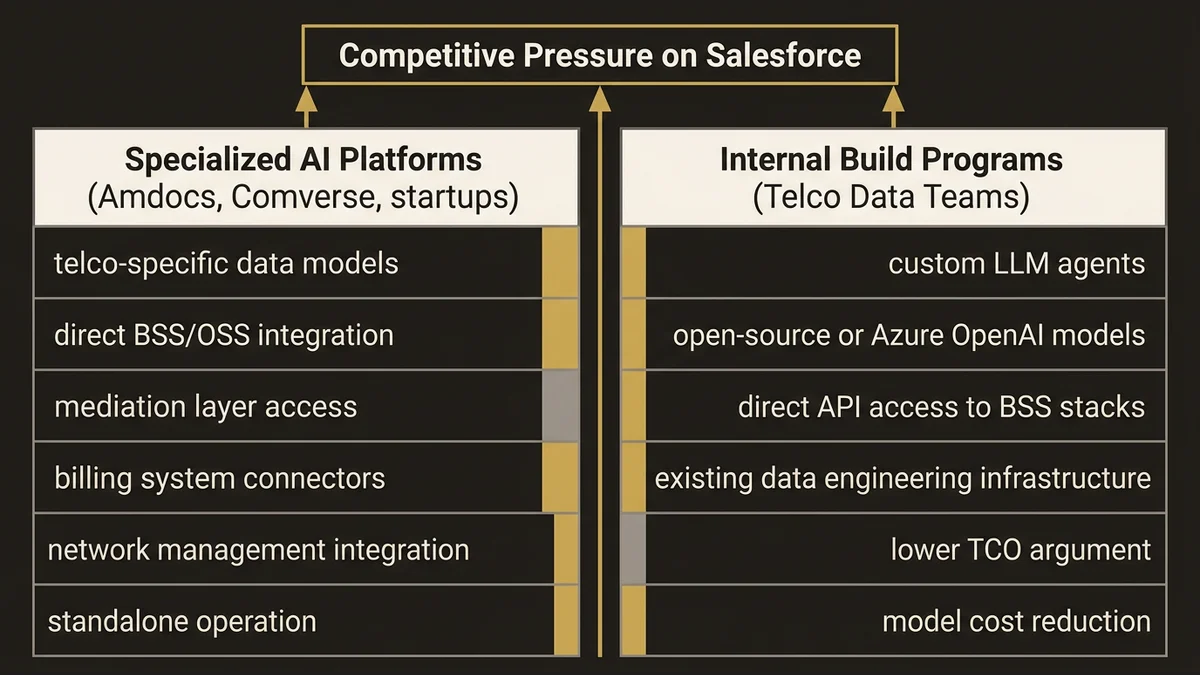
The real pressure comes from two directions simultaneously. First, specialized AI platforms built specifically for telco operations: churn prediction engines, network-aware service bots, BSS/OSS-integrated automation tools from vendors like Amdocs, Comverse, and a growing set of AI-native startups. These platforms go deep on telco-specific data models and integrate directly with mediation layers, billing systems, and network management platforms. They don’t need Salesforce to function.
Second, internal build programs. Telcos with mature data engineering teams are building custom LLM-powered agents on top of their existing BSS stacks, using open-source models or Azure OpenAI, with direct API access to their operational systems. The total cost of ownership argument for these builds has gotten more credible as model costs dropped and tooling matured.
Agentforce Communications is Salesforce’s answer to both. The architecture it implies is worth examining carefully.
Where the Moat Actually Sits
The surface-level answer is “industry-specific agents.” That’s not a moat. Any vendor can train a model on telco data and call it industry-specific.
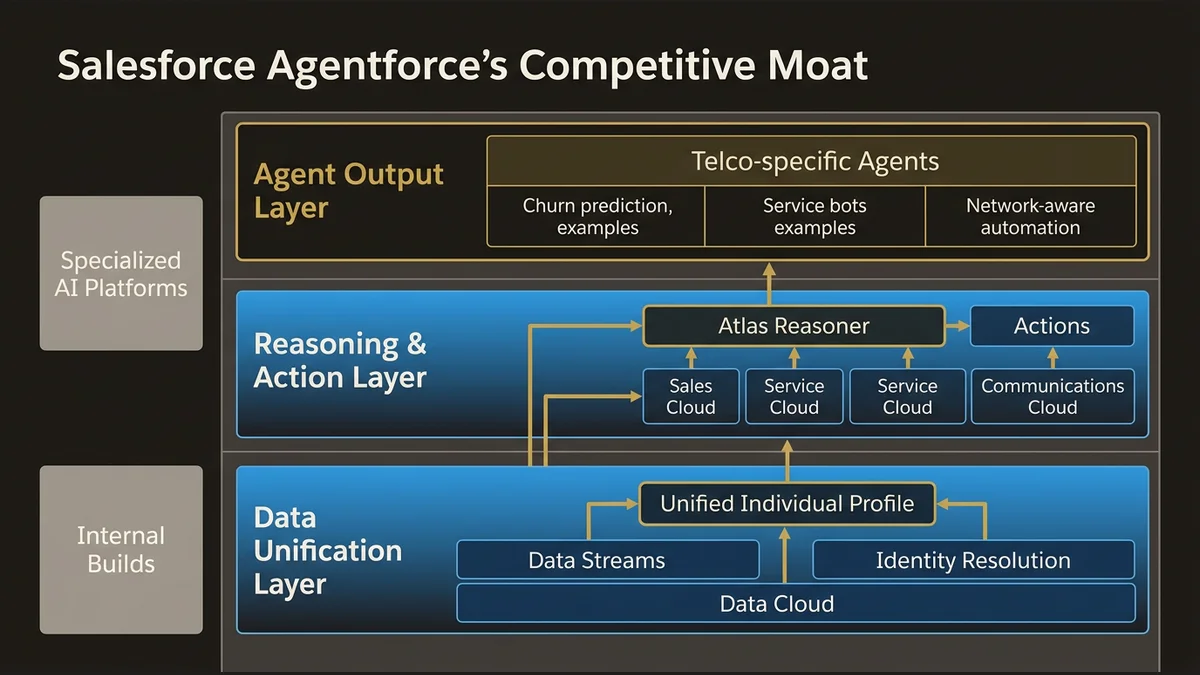
The actual moat Salesforce is building has three layers, and they compound.
Data unification as the foundation. Agentforce agents are only as good as the context they operate on. In telco, that context spans billing records, network event logs, service history, contract terms, and real-time usage data. Most specialized AI platforms have to solve this integration problem themselves, building connectors to each source system. Salesforce’s position is that Data Cloud handles this through Data Streams and Identity Resolution, producing a Unified Individual profile that agents can query at inference time. If that profile is accurate and current, the agent’s reasoning quality improves substantially. If it isn’t, the agent halves its own value.
This is the architectural bet. Salesforce is saying: the hard problem isn’t the AI, it’s the data substrate. They’re right. And they have a head start on that substrate in orgs that already run Sales Cloud, Service Cloud, or Communications Cloud.
The reasoning layer on top of CRM actions. The Atlas Reasoning Engine doesn’t just generate text. It selects and sequences Actions, which are discrete operations against Salesforce objects and external APIs. In a telco context, that means an agent can check a customer’s current plan, identify an upgrade eligibility window, verify network coverage at their address, and initiate a quote, all within a single reasoning chain. A specialized AI platform can do parts of this. Doing all of it, with full audit trail and CRM state persistence, requires either Salesforce or a significant custom build.
The governance and compliance surface. Telcos operate under heavy regulatory scrutiny. GDPR in Europe, CPNI regulations in the US, sector-specific data residency requirements. Agentforce inherits Salesforce’s existing trust architecture: field-level security, permission sets, audit logs, data masking through Data Cloud policies. A custom-built agent solution has to reconstruct all of this. A specialized AI vendor has to certify against it. Salesforce ships it as table stakes.
These three layers don’t individually win the competitive argument. Together, they create a switching cost that compounds over time as more telco data flows through Data Cloud and more agent workflows get embedded in operational processes.
What Specialized Platforms Still Do Better
Intellectual honesty requires acknowledging where Agentforce Communications has real gaps, at least today.
Network-layer integration is the clearest one. Agentforce operates at the CRM and BSS layer. It doesn’t have native connectors to OSS systems, network management platforms, or mediation layers. A telco running Ericsson or Nokia network management infrastructure needs MuleSoft or a custom integration layer to surface network event data into Data Cloud before any agent can reason on it. Specialized platforms from vendors who live in the OSS/BSS stack have this integration pre-built.
The latency profile is also different. Real-time network event correlation, the kind needed for proactive outage notification or dynamic SLA management, requires sub-second data freshness. Data Cloud’s typical activation latency for real-time Data Streams sits in the 2-5 minute range for most enterprise configurations. That’s acceptable for many service scenarios. It’s not acceptable for network-triggered interventions.
For telcos where the primary AI use case is network operations rather than customer-facing service, a specialized platform is still the better architectural choice. Agentforce Communications is optimized for the customer engagement layer, not the network layer.
The Custom Build Calculus
The internal build argument deserves a direct response, because it’s the one that’s gotten more credible.
A telco with a mature data platform, an existing BSS integration layer, and an internal AI team can absolutely build LLM-powered agents. The question isn’t whether they can. The question is what they’re trading away.
Custom builds optimize for the current requirement. They’re fast to the first use case and slow to the second. Every new agent workflow requires re-solving the same problems: data access patterns, security boundaries, action orchestration, testing frameworks, rollback mechanisms. In Agentforce, those are solved once at the platform level and inherited by every agent.
The maintenance surface is the other factor. LLM behavior changes as models are updated. Prompt engineering that works today may degrade with the next model version. Salesforce manages this through Prompt Builder templates and the Agentforce Testing Center, which provides regression testing for agent behavior. A custom build team owns this problem entirely.
At scale, meaning 50+ agent workflows across multiple business units, the custom build approach typically requires a dedicated platform team of 8-12 engineers just to maintain the infrastructure layer. That cost rarely appears in the initial build-vs-buy analysis.
How This Reshapes the Competitive Landscape Over 24 Months
The current competitive picture will look different by 2028, and the decisions telcos make now determine which side of that shift they’re on.
Salesforce’s trajectory is clear: more industry-specific agent templates, deeper Data Cloud integration, and continued investment in the Atlas Reasoning Engine’s ability to handle multi-step telco workflows. Each Agentforce Communications release narrows the gap with specialized platforms on the use cases that matter most for customer engagement.
Specialized AI vendors face a different trajectory. They have deep telco domain knowledge and OSS/BSS integration, but they’re building CRM and data unification capabilities from scratch. That’s a harder problem than it looks. The telco AI vendors who survive will be the ones who either partner with Salesforce (positioning themselves as the network layer that feeds Data Cloud) or go deep enough on network operations that they’re not competing on the same use cases at all.
The custom build programs face the most pressure. As Agentforce Communications matures, the gap between what a custom build delivers and what the platform delivers narrows, while the maintenance cost of the custom build grows. Most internal build programs will either migrate to Agentforce or get absorbed into a Center of Excellence that standardizes on the platform. The orgs that built on open standards and clean API boundaries will migrate cleanly. The ones that built tightly coupled to specific model versions or proprietary tooling will face a painful transition.
For architects advising telcos right now, the strategic question isn’t “is Agentforce better than the alternative today?” It’s “which platform will have the better architecture in 24 months, and what does it cost to switch if we’re wrong?”
On that framing, Agentforce Communications has a credible case. The data substrate advantage compounds. The governance surface is already enterprise-grade. The OSS/BSS integration gap is real but addressable through MuleSoft. The custom build maintenance burden grows with scale.
The specialized platform argument holds for network operations use cases. It weakens significantly for customer engagement, service automation, and commercial workflows, which is where most telco AI investment is actually going.
Key Takeaways
- Agentforce Communications competes on platform depth, not feature parity. The moat is the combination of Data Cloud’s unified profile, Atlas Reasoning Engine’s action orchestration, and Salesforce’s inherited governance architecture.
- Specialized telco AI platforms retain a genuine advantage at the network operations layer, where OSS/BSS integration depth and sub-second latency requirements exceed what Agentforce currently delivers.
- Custom build programs are viable at small scale and become increasingly expensive to maintain past 20-30 agent workflows. The platform overhead that Agentforce absorbs typically requires 8-12 dedicated engineers to replicate internally.
- The switching cost argument favors Salesforce in orgs already running Communications Cloud or Service Cloud. The more telco data flows through Data Cloud, the harder it becomes to migrate agent workflows to an alternative platform.
- The 24-month trajectory matters more than the current feature comparison. Telcos making platform decisions now should model the maintenance cost of alternatives at 2x their current agent workflow count, not their current count.
For a deeper look at how Data Cloud’s identity resolution architecture underpins agent context quality, see the Data Cloud Identity Resolution Architecture article. If you’re evaluating where Agentforce fits in a broader multi-cloud telco architecture, the Agentforce for Telco Architecture Guide covers the deployment patterns in detail. For an assessment of your current Salesforce architecture’s readiness for agentic workloads, the Org Health & Recovery Architecture service is the right starting point.
Need help with ai & agentforce architecture?
Design and implement Salesforce Agentforce agents, Prompt Builder templates, and AI-powered automation across Sales, Service, and Experience Cloud.
Related Articles

Agentforce Operations: Architecture Guide
Agentforce Operations redefines back-office automation. Here's the architectural blueprint for deterministic agent control planes at enterprise scale.

Salesforce Prompt Builder : bonnes pratiques
Prompt Builder mal configuré = agents Agentforce imprévisibles. Les bonnes pratiques architecturales pour éviter les pièges les plus coûteux.

Salesforce AI Specialist Cert Prep 2026
The Salesforce AI Specialist certification in 2026 tests architecture judgment, not recall. Here's how to prepare for what the exam actually measures.