
The Cimulate acquisition closed March 3, 2026. It doesn’t just change Commerce Cloud’s feature roadmap. It changes who owns your AI training data, and most enterprise architects haven’t mapped that exposure yet. Cimulate AI data governance Salesforce implications are already in motion, and the compliance obligations that follow will land before most teams finish their next sprint cycle.
Why Training Data Ownership Is the Actual Risk
Most post-acquisition analysis focuses on product integration timelines. That’s the wrong frame.
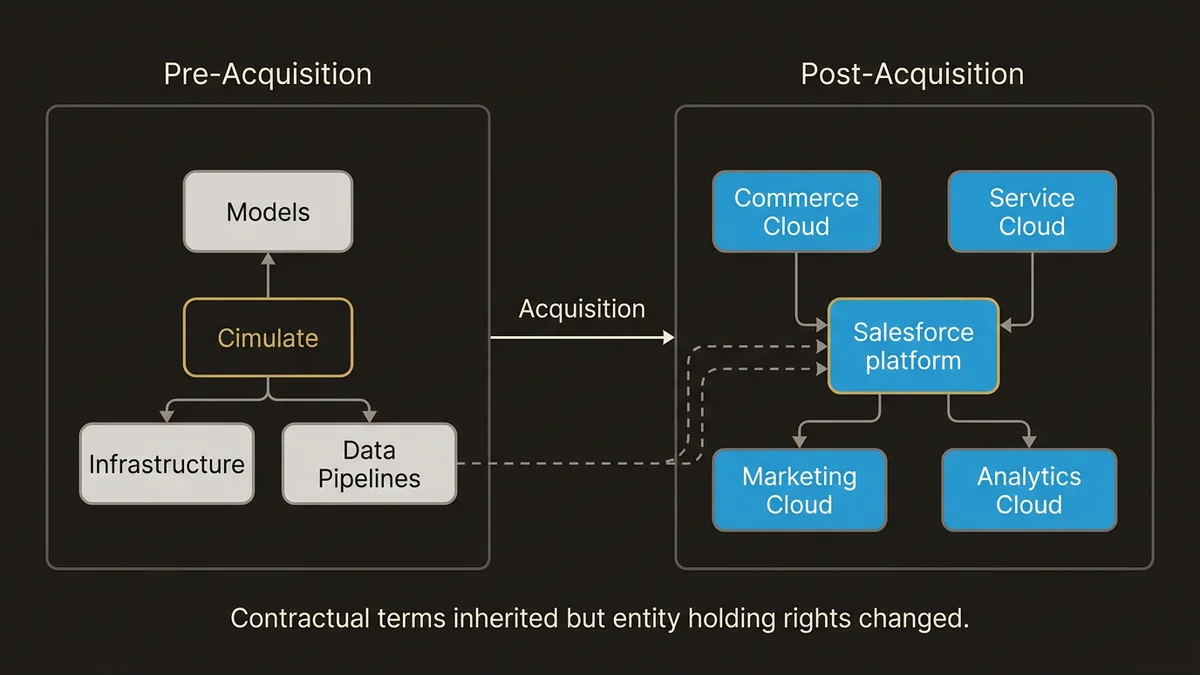
The acquisition is complete. Cimulate’s team is inside Salesforce, and its intent-aware context engine is being absorbed into Agentforce Commerce. That means the models, the infrastructure, and the data pipelines that trained those models have transferred to a new legal entity. Cimulate’s core capability was behavioral AI for commerce: learning from product catalog interactions, search patterns, and purchase signals to drive discovery. That learning didn’t happen in a vacuum. It happened on your data.
The question enterprise architects need to answer is specific: what data did Cimulate’s models train on, under what contractual terms, and does Salesforce’s completed acquisition change those terms? (The specifics below are inferences based on how behavioral AI commerce platforms typically operate. Validate against your own contract language and Cimulate’s published data processing terms before treating any single claim as load-bearing for your audit.)
In practice, most SaaS AI vendors operate under data processing agreements that permit model training on anonymized or aggregated behavioral signals. The vendor retains the right to improve the model using your usage data. That’s standard. What changes post-acquisition is the entity holding that right. Salesforce is now the counterparty, and Salesforce has a broader platform with more surfaces where that trained intelligence can appear. With Cimulate’s shopper-intent models now feeding Agentforce Commerce directly, the scope of that exposure is no longer theoretical.
This isn’t hypothetical risk. It’s a contractual and architectural audit item with a closed transaction behind it.
What the Cimulate Data Model Actually Touched
Understanding the governance exposure requires understanding what Cimulate processed. The platform operated at the intersection of three data categories that carry distinct compliance weights.
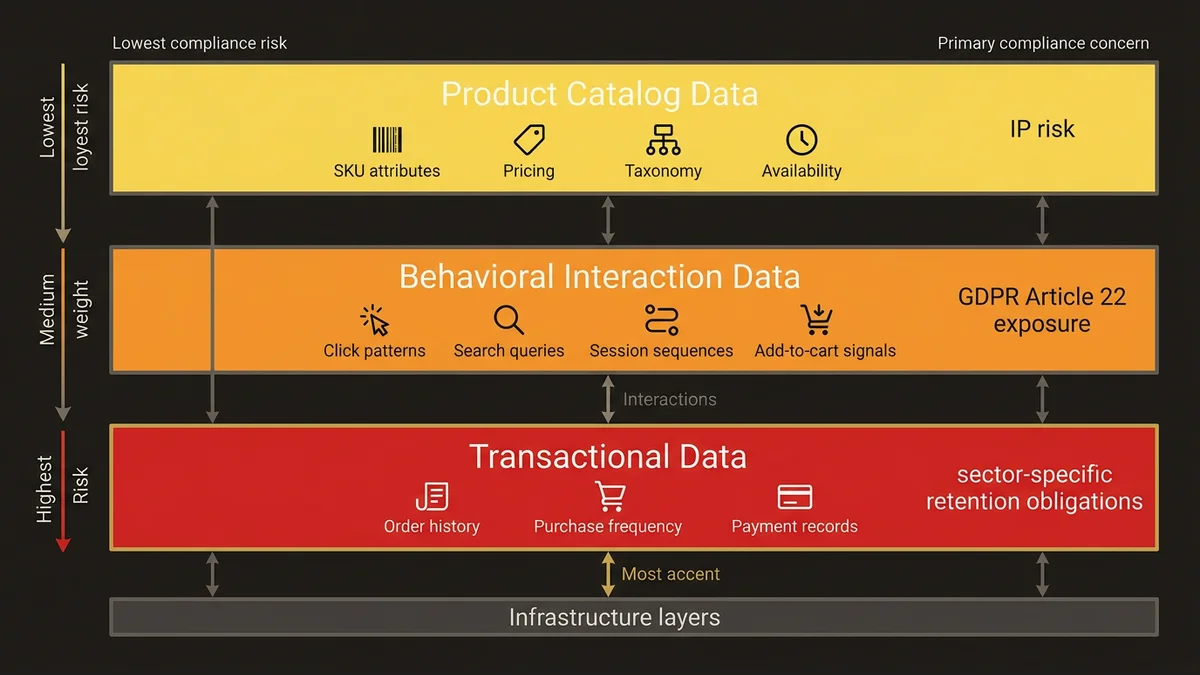
Product catalog data is the least sensitive. SKU attributes, pricing, taxonomy, availability signals. Most orgs treat this as internal operational data with minimal regulatory exposure. The risk here is IP, not privacy.
Behavioral interaction data is where it gets complicated. Click patterns, search queries, session sequences, add-to-cart signals. In B2C contexts, this data is tied to identifiable individuals. Under GDPR Article 22 and similar frameworks, automated decision-making based on individual behavioral profiles requires a lawful basis. If Cimulate’s models were trained on behavioral data tied to EU data subjects, and that training data was processed without explicit consent for AI model improvement, there’s a compliance gap that the acquisition doesn’t resolve. It inherits.
Transactional data is the highest-risk category. If Cimulate’s integration touched order history or purchase frequency to improve recommendation accuracy, that data likely falls under stricter retention and processing obligations in regulated industries. Retail financial services, healthcare commerce, and any org operating under sector-specific data laws needs to audit this specifically.
The architecture that works here is a data lineage trace: map every Cimulate integration point back to the data categories it consumed, then cross-reference against your existing data processing agreements and consent frameworks.
Three Compliance Obligations That Shift at Acquisition
Most teams treat vendor compliance as a one-time due diligence exercise at contract signing. Acquisitions break that assumption. Here are the three obligations that require re-evaluation now.
Data Processing Agreement re-execution. Your DPA was with Cimulate as an independent entity. Salesforce is a different legal entity with different sub-processor lists, different data transfer mechanisms, and different Standard Contractual Clauses. If your org is subject to GDPR, CCPA, or any adequacy-dependent transfer framework, the closed acquisition triggers a re-execution requirement. This isn’t optional. Continuing to operate under the original DPA with a new counterparty is a compliance gap that regulators have cited in enforcement actions.
Sub-processor notification obligations. Under GDPR Article 28, controllers must be notified of sub-processor changes and have the right to object. Salesforce’s acquisition of Cimulate means Salesforce’s sub-processor infrastructure now processes data that previously ran through Cimulate’s independent stack. Your DPO needs to assess whether this constitutes a sub-processor change requiring customer notification downstream.
AI-specific regulatory exposure. The EU AI Act classifies certain recommendation systems as high-risk AI when they influence consumer behavior at scale. With Cimulate’s models now integrated into Agentforce Commerce, the combined system may cross classification thresholds that the standalone Cimulate deployment did not. Enterprise architects building on top of this stack need to assess whether the integrated architecture triggers new conformity obligations.
For a deeper look at how GDPR obligations interact with Salesforce’s AI architecture, the earlier analysis on RGPD and Salesforce AI implications for DSIs covers the regulatory mechanics in detail.
The Audit Framework Enterprise Architects Should Run Now
This is the sequence that surfaces actual exposure, not theoretical risk.
Step 1: Map the integration surface. Identify every point where Cimulate connected to your Salesforce org or external systems. API calls, data streams, Commerce Cloud hooks, any custom integration built on top of Cimulate’s endpoints. Document the data categories flowing across each connection.
Step 2: Classify by regulatory jurisdiction. For each data category, identify which data subjects are affected and which regulatory frameworks apply. B2B orgs with no EU customers have a different exposure profile than B2C orgs with GDPR obligations. Don’t apply a uniform compliance posture across jurisdictions with different requirements.
Step 3: Review the original Cimulate contract. Specifically: the data processing terms, the model training clauses, the data retention schedule, and any provisions governing what happens to trained models if the vendor is acquired. Some enterprise contracts include acquisition clauses that require data deletion or model retraining on acquisition. Most don’t. Know which category you’re in.
Step 4: Assess the Salesforce DPA. Salesforce publishes its Data Processing Addendum publicly. Cross-reference your Cimulate data flows against Salesforce’s current sub-processor list and data transfer mechanisms. Identify gaps between what Cimulate’s DPA permitted and what Salesforce’s DPA covers.
Step 5: Engage your DPO before Salesforce migrates the remaining infrastructure. The technical migration is underway. The window for compliance intervention is narrowing, not opening.
This audit connects directly to the broader data model changes the acquisition introduces, which the Cimulate acquisition and Commerce Cloud data model analysis covers from an architectural integration perspective.
What Happens When This Integrates with Data Cloud
The governance risk isn’t the Cimulate integration in isolation. It’s what happens when Cimulate’s behavioral AI gets absorbed into Data Cloud’s Identity Resolution and Calculated Insights pipelines, which is exactly where Salesforce is taking it.
Data Cloud’s architecture is designed to unify behavioral signals across touchpoints into a Unified Individual profile. Cimulate’s shopper-intent models, now feeding Agentforce Commerce, generate exactly the kind of behavioral signal that Data Cloud is built to ingest. Behavioral data Cimulate processed in a relatively contained commerce context is now a candidate for a much broader cross-channel identity graph. The consent basis that covered Cimulate’s original processing may not cover that expanded use.
In enterprise orgs with 3,000+ retail touchpoints, the typical Data Cloud Identity Resolution run produces Unified Individual profiles that aggregate signals from dozens of source systems. Adding Cimulate-derived behavioral training data to that graph changes the profile’s composition and potentially its regulatory classification. A behavioral profile used for product recommendations has a different legal basis than a unified identity profile used for automated decisioning across channels.
Salesforce’s broader 2026 platform direction reinforces this trajectory. The expanded Data Cloud capabilities for real-time customer data unification, combined with Agentforce’s cross-channel agent orchestration, create a data substrate where Cimulate’s commerce signals don’t stay in commerce. They become inputs to a unified decisioning layer. That’s the product vision. It’s also a governance surface that grows faster than most compliance teams can track.
The architecture decision that matters here: if your org is planning to connect Cimulate-derived behavioral models to Data Cloud Data Streams, that connection should go through a consent and purpose-limitation review before it goes through a technical integration review. Most teams do it in the wrong order.
For orgs building AI agents on top of this data layer, the Agentforce implementation guide covers how to structure data access controls within the Agentforce architecture to limit agent exposure to sensitive profile data.
The Forward-Looking Frame
The acquisition is closed. The technical integration is in progress. The governance window that existed between announcement and close has passed for most orgs.
What remains is the window between current integration state and full production deployment of the unified Agentforce Commerce architecture. That window is measured in months, not quarters. Orgs that run the DPA re-execution, complete the data lineage audit, and build consent frameworks covering the expanded use cases now will have clean documentation when regulators start asking about AI training data provenance. EU AI Act enforcement timelines are compressing. The orgs without lineage documentation will have a materially different experience.
The specific risk to track: as Salesforce positions Agentforce Commerce against Adobe, Shopify, and SAP in the agentic commerce space, the competitive pressure to ship integrated features accelerates. Technical integration timelines compress. Compliance review cycles don’t. That gap is where governance exposure accumulates.
Key Takeaways
- The Cimulate acquisition closed March 3, 2026, transferring AI training data rights to Salesforce as the new legal counterparty and triggering DPA re-execution requirements for GDPR and CCPA-regulated orgs.
- Behavioral interaction data processed by Cimulate carries distinct compliance weight from catalog data; orgs with EU data subjects need to audit the lawful basis for model training on that data specifically.
- The EU AI Act may reclassify the combined Cimulate/Agentforce Commerce recommendation architecture as high-risk AI if it crosses consumer influence thresholds the standalone Cimulate deployment did not reach.
- Connecting Cimulate behavioral models to Data Cloud Identity Resolution pipelines requires a consent and purpose-limitation review before technical integration begins, not after.
- The compliance intervention window is narrowing as Salesforce’s technical migration progresses; waiting for a stable integration state before running the audit is the highest-risk posture available.
Need help with ai & agentforce architecture?
Design and implement Salesforce Agentforce agents, Prompt Builder templates, and AI-powered automation across Sales, Service, and Experience Cloud.
Related Articles

Agentforce Operations: Architecture Guide
Agentforce Operations redefines back-office automation. Here's the architectural blueprint for deterministic agent control planes at enterprise scale.

Salesforce Prompt Builder : bonnes pratiques
Prompt Builder mal configuré = agents Agentforce imprévisibles. Les bonnes pratiques architecturales pour éviter les pièges les plus coûteux.

Salesforce AI Specialist Cert Prep 2026
The Salesforce AI Specialist certification in 2026 tests architecture judgment, not recall. Here's how to prepare for what the exam actually measures.