Most telco organizations treated Agentforce Communications as a technology decision. It is not. The Salesforce Agentforce skills transformation telco teams now face is fundamentally an organizational problem wearing a technology costume.
The platform is ready. The people are not.
Why Telco Teams Are Structurally Unprepared
Telco Salesforce teams were built for a different era. The typical configuration: a handful of admins managing declarative configuration, a developer or two handling Apex and integrations, and a business analyst bridging the gap between IT and commercial operations. That structure worked when Salesforce was a system of record. It breaks under Agentforce.
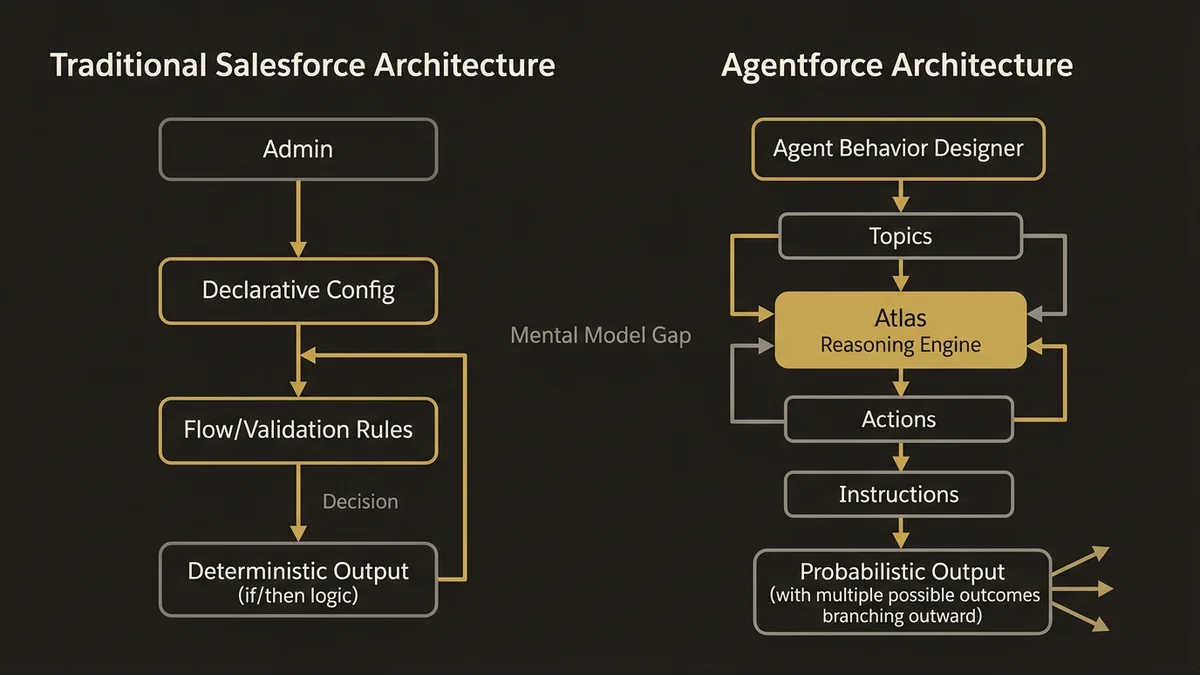
Agentforce Communications introduces autonomous agents that reason across Topics, execute Actions, and adapt behavior based on Instructions. The Atlas Reasoning Engine doesn’t follow a script. It interprets context, selects tools, and makes sequential decisions. Configuring that system requires a fundamentally different mental model than configuring a Flow or writing a validation rule.
The gap isn’t just technical. It’s conceptual. Most telco Salesforce practitioners have never had to think about agent behavior design, prompt engineering at the enterprise level, or the failure modes of probabilistic systems. They’ve been trained to think deterministically: if this, then that. Agentforce doesn’t work that way, and the training programs that exist today largely haven’t caught up.
The Three Roles Telco Orgs Are Missing
There are three roles that become critical once Agentforce Communications goes live. Most telco organizations have none of them.
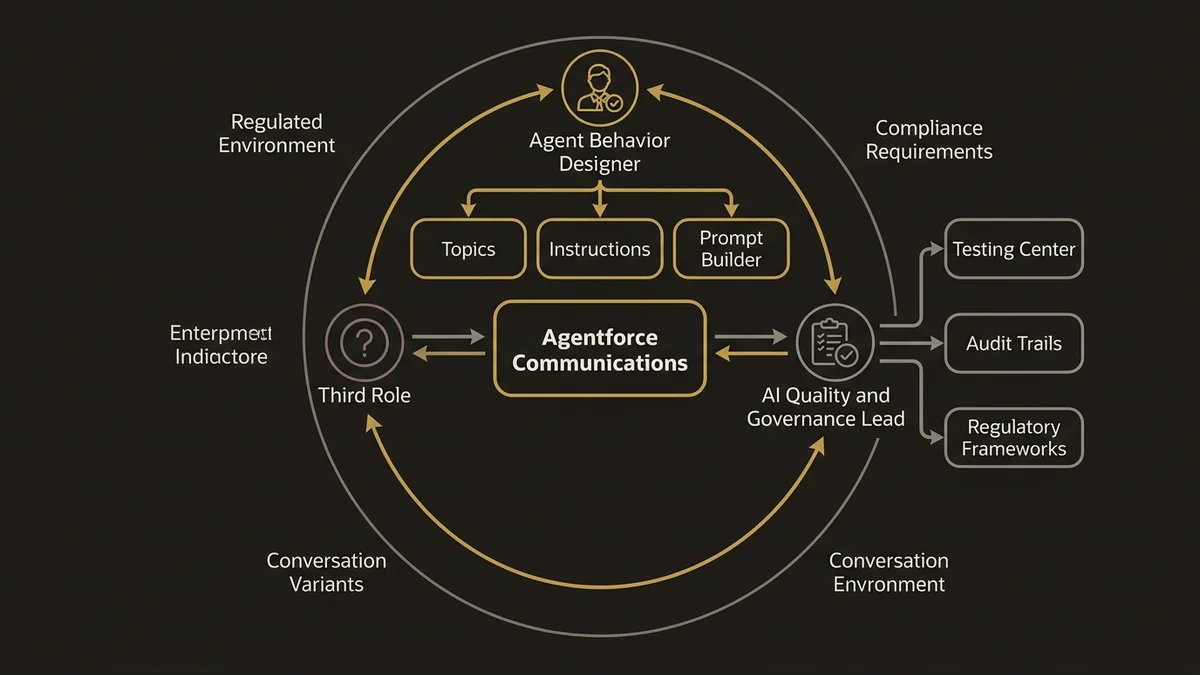
Agent Behavior Designer. This person sits between business and technology. They define what an agent should do in a given context, how it should escalate, what it should never say, and how its Instructions should be written to produce consistent behavior. This is not a traditional BA role. It requires understanding how the Atlas Reasoning Engine interprets context, how Topics scope agent behavior, and how to test for edge cases that a deterministic system would never produce. In practice, this role is closest to a product manager for AI systems, but with enough Salesforce depth to translate decisions into Prompt Builder templates and agent configuration.
AI Quality and Governance Lead. Telco operates in a regulated environment. Agents handling contract modifications, service interruptions, or billing disputes carry compliance exposure. Someone needs to own the testing regimen in Agentforce Testing Center, define what “acceptable” agent behavior looks like across thousands of conversation variants, and maintain audit trails that satisfy both internal legal teams and external regulators. The role demands fluency with probabilistic output: knowing when a 95% accuracy rate is acceptable and when it isn’t, plus the ability to build governance frameworks that don’t exist in any Salesforce certification today. Repurposing a QA analyst doesn’t fill it.
Data Readiness Architect. Agentforce agents are only as good as the data they reason over. In telco, that means network inventory, provisioning status, billing history, and contract entitlements, often spread across BSS/OSS systems that predate Salesforce by a decade. Someone needs to own the Data Cloud layer: designing Data Streams, maintaining Data Model Objects, ensuring Identity Resolution rulesets produce clean Unified Individuals, and keeping Calculated Insights current enough to be useful in real-time agent decisions. Most telco orgs have a Data Cloud admin. They don’t have a Data Readiness Architect who understands the full chain from source system to agent reasoning.
What Retraining Actually Requires
The instinct is to send people to Trailhead and call it done. That works for feature adoption. It doesn’t work for capability transformation.
The skills gap in Agentforce Communications deployments has two layers. The surface layer is technical: learning the Agentforce configuration model, understanding how Topics and Actions interact, getting comfortable with Prompt Builder’s Flex template type for dynamic agent responses. That layer is addressable through structured training over six to eight weeks.
The deeper layer is harder. It’s the shift from deterministic thinking to probabilistic thinking. Telco Salesforce practitioners are trained to eliminate ambiguity. Agentforce requires them to manage it. An agent that handles 94% of billing queries correctly is a success. The same accuracy rate on a network provisioning workflow might be unacceptable. Knowing the difference, and designing systems accordingly, requires a different cognitive framework than most Salesforce professionals have been asked to develop.
The retraining programs that work in practice combine three elements. First, hands-on agent design workshops where practitioners build and break agents in sandbox environments, specifically to understand failure modes. Second, cross-functional sessions that bring together Salesforce admins, BSS/OSS integration owners, and compliance teams, because agent behavior decisions can’t be made in isolation. Third, a governance simulation where teams walk through a real escalation scenario and map every decision point to an owner. That last exercise consistently surfaces the organizational gaps that no amount of technical training closes.
The Organizational Restructuring Question
Technology adoption without structural change produces shelf-ware. Agentforce Communications is expensive shelf-ware if the org chart doesn’t change to support it.
The architecture that works here is a small, dedicated AI Operations function sitting adjacent to the existing Salesforce Center of Excellence. Not inside it, because the CoE’s incentives are oriented toward stability and governance of existing systems. AI Operations needs to move faster, tolerate more ambiguity, and iterate on agent behavior weekly rather than quarterly.
That function needs three things: clear ownership of agent performance metrics (containment rate, escalation rate, resolution accuracy), a direct line to the business units whose processes the agents are executing, and the authority to modify agent configuration without a full change management cycle. The last point is where most telco organizations stall. They apply the same change governance to agent Instructions updates that they apply to core CRM schema changes. Those are not equivalent risks, and treating them as such kills the iteration speed that makes Agentforce valuable.
The relationship between this AI Operations function and the broader IT organization also needs explicit definition. Data Cloud configuration, BSS/OSS integration via MuleSoft, and Platform Events that feed real-time network status into agent context, these are IT-owned dependencies. If AI Operations can’t get Data Stream updates prioritized, agent quality degrades. That dependency needs a service-level agreement, not a ticket queue.
The technical foundation underneath this organizational layer is covered in the Agentforce for Telco architecture guide.
The Certification Gap and What to Do About It
Salesforce’s current certification path doesn’t map cleanly to what Agentforce Communications deployments require. The AI Associate and AI Specialist certifications cover foundational concepts. They don’t cover agent behavior design for regulated industries, Data Cloud readiness for real-time agent reasoning, or governance frameworks for probabilistic systems.
That gap is real and it’s not closing quickly. The practical response is to build internal certification criteria rather than waiting for Salesforce to define them. Identify the five or six competencies that matter for your specific deployment: agent configuration, Prompt Builder template design, Agentforce Testing Center methodology, Data Cloud data quality assessment, compliance escalation design, and BSS/OSS integration pattern knowledge. Define what proficiency looks like for each. Assess your current team against that rubric. The delta is your training roadmap.
This approach also surfaces something useful: which gaps can be closed through training and which require new hires or specialist partners. In most telco organizations running Agentforce Communications at scale, at least one of the three critical roles described above will need to be sourced externally, at least initially. The Data Readiness Architect role in particular is rare enough that building it internally from scratch adds six to twelve months to a deployment timeline that most commercial teams won’t accept.
For organizations evaluating what that specialist engagement should look like, Agentforce architecture services covers the scope of what a senior architect brings to this kind of deployment.
Key Takeaways
- Organizational readiness, not technology readiness, is the gating problem. The platform works; the team doesn’t, yet.
- Three roles are structurally absent in most telco Salesforce orgs: Agent Behavior Designer, AI Quality and Governance Lead, Data Readiness Architect. Decide which to hire versus develop first.
- Two retraining tracks. Two timelines. Six to eight weeks for technical Agentforce configuration; longer for probabilistic systems thinking, which only sticks through structured practice with real failure scenarios.
- A dedicated AI Operations function adjacent to (not inside) the existing CoE is what sustains agent performance. Without it, no one owns the iteration cycle as business requirements evolve.
- Build the internal competency rubric now. Salesforce certifications don’t cover what Agentforce Communications deployments require, and waiting for them is the slower path to a qualified team.
Need help with ai & agentforce architecture?
Design and implement Salesforce Agentforce agents, Prompt Builder templates, and AI-powered automation across Sales, Service, and Experience Cloud.
Related Articles

Agentforce Operations: Architecture Guide
Agentforce Operations redefines back-office automation. Here's the architectural blueprint for deterministic agent control planes at enterprise scale.

Salesforce Prompt Builder : bonnes pratiques
Prompt Builder mal configuré = agents Agentforce imprévisibles. Les bonnes pratiques architecturales pour éviter les pièges les plus coûteux.

Salesforce AI Specialist Cert Prep 2026
The Salesforce AI Specialist certification in 2026 tests architecture judgment, not recall. Here's how to prepare for what the exam actually measures.