
Most enterprise AI platform decisions get made by procurement teams comparing feature matrices. That is the wrong frame entirely. The agentforce vs microsoft copilot enterprise question is not about features; it is about where your AI agents live relative to your data and your processes, and the architectural consequences of that choice will compound for years.
The Core Architectural Difference That Actually Matters
Microsoft Copilot is a horizontal AI layer built on top of Microsoft 365 and Azure. It reasons over documents, emails, Teams conversations, and whatever you pipe into it via connectors. The mental model is: AI that helps people work inside productivity tools.
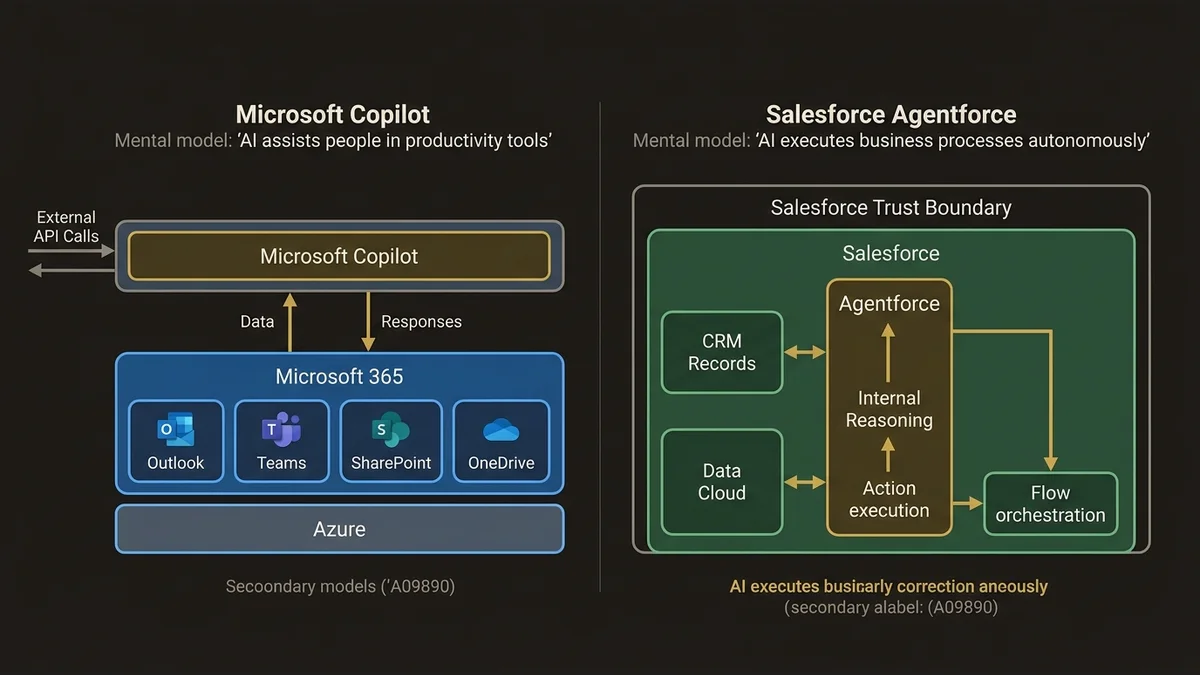
Agentforce is a vertical AI layer built inside the CRM execution context. It reasons over customer records, pipeline data, case histories, and real-time behavioral signals from Data Cloud. The mental model is: AI that executes business processes on behalf of people and systems.
These are not competing implementations of the same idea. They solve different problems. The mistake enterprises make is treating them as substitutes when the real question is which problem they are actually trying to solve.
If your primary use case is “help my employees write better emails and summarize meetings,” Copilot wins. It is deeply integrated into the tools where that work already happens. Trying to replicate that with Agentforce would be architecturally absurd.
If your primary use case is “autonomously qualify leads, route cases, and trigger downstream revenue processes without human intervention,” Agentforce wins. Copilot has no native concept of a Salesforce Opportunity stage, a Case escalation rule, or a Data Cloud Segment. You would spend months building connectors to approximate what Agentforce does natively.
Where Agentforce Has a Structural Advantage
The Atlas Reasoning Engine is what makes Agentforce architecturally distinct. It does not just generate text; it reasons over a grounded context that includes live CRM records, Calculated Insights from Data Cloud, and the current state of business processes. When an Agentforce agent decides to escalate a case or recommend a next best action, that decision is grounded in the actual data model of your Salesforce org, not a summarized document.
This matters enormously at scale. In enterprise orgs with 3,000+ customer touchpoints, the latency and accuracy of AI decisions depend on how close the reasoning layer sits to the data. Agentforce Topics and Actions operate inside the Salesforce trust boundary, which means no data leaves the platform to be processed by an external model before a decision is made. Data Cloud Data Graphs enable pre-computed joins across unified customer profiles, so the agent is not doing expensive real-time lookups; it is reasoning over materialized views that are already optimized for the query patterns agents need.
Copilot’s architecture requires data to travel: from your CRM, through a connector, into Azure OpenAI, back through the connector, and into the response. Each hop introduces latency, potential data residency issues, and a dependency on connector reliability. For productivity tasks, this is acceptable. For autonomous business process execution where an agent is making decisions that trigger Flow orchestration or update records, it is a meaningful liability.
The Identity Resolution layer in Data Cloud is another structural advantage. When an Agentforce agent is reasoning about a customer, it is working from a Unified Individual; a profile that has already resolved duplicate records, merged behavioral signals from multiple channels, and applied your org’s matching rulesets. Copilot has no equivalent concept. It sees whatever data you surface to it, with no native deduplication or unification layer.
Where Microsoft Copilot Has a Structural Advantage
Copilot’s advantage is breadth of context and enterprise content integration. It can reason over SharePoint documents, Teams conversations, Outlook threads, and structured data simultaneously. For knowledge workers who need AI assistance that spans the full surface area of their work; not just CRM data; this is genuinely valuable.
The Microsoft Graph is a powerful substrate. It represents the full topology of how people, documents, and communications relate inside an organization. Copilot can surface insights from that graph in ways Agentforce cannot, because Agentforce has no visibility into your document management system or your internal communications by default.
For industries where the work product is documents; legal, financial services, consulting; Copilot’s document-native reasoning is a real advantage. An Agentforce agent cannot natively summarize a contract stored in SharePoint and use that summary to update a Salesforce record without custom integration work. Copilot can do the first part natively.
Copilot Studio also gives Microsoft a low-code agent builder that is more accessible to non-technical teams than Agentforce’s configuration model. The tradeoff is depth: Copilot Studio agents are easier to build but harder to make reliable in complex, multi-step business process scenarios where the Atlas Reasoning Engine’s structured reasoning approach has a clear edge.
The Integration Architecture Question
The real enterprise decision is rarely either/or. The architecture that works in mature enterprise deployments is a division of responsibility: Copilot handles productivity surface area, Agentforce handles CRM process execution, and MuleSoft or a similar integration layer handles the handoffs between them.
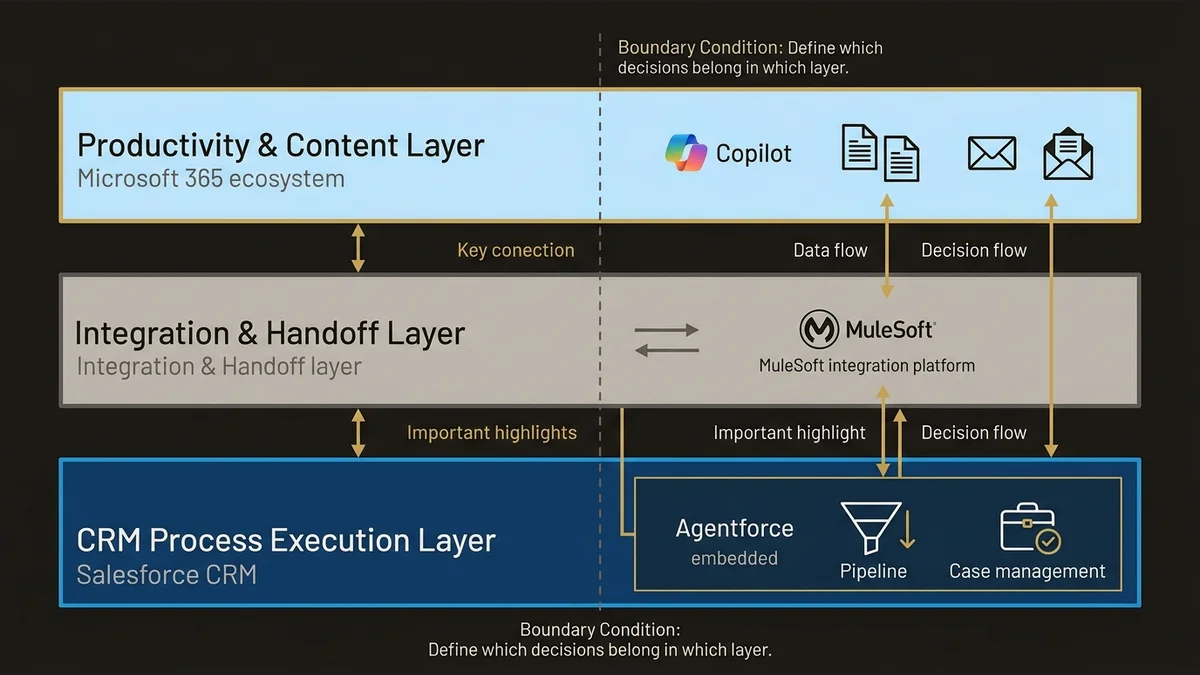
This is not fence-sitting; it is recognizing that the two platforms have non-overlapping strengths and that forcing one to cover the other’s territory creates technical debt. The mistake is letting one vendor’s sales team convince you that their platform can do everything. It cannot. Neither can.
What you need to define before making any platform commitment is the boundary condition: which AI decisions need to be grounded in CRM data and trigger CRM processes, and which AI decisions need to be grounded in enterprise content and trigger productivity workflows? That boundary determines your architecture.
For revenue-generating processes; lead qualification, opportunity progression, case resolution, renewal risk detection; Agentforce is the right execution layer. The Prompt Builder templates, the Flow orchestration integration, and the Data Cloud Segment activation all assume a Salesforce data model. Building that on Copilot would require you to replicate the CRM context externally, which is both expensive and fragile.
For employee productivity; drafting proposals, summarizing research, preparing for meetings; Copilot is the right layer. Trying to route those workflows through Agentforce would be architecturally wasteful and would produce worse results because Agentforce has no native access to the document and communication context those tasks require.
You can read more about how Agentforce’s reasoning architecture handles complex multi-step decisions in the Atlas Reasoning Engine breakdown, which covers what the reasoning layer actually does under the hood versus what the marketing materials suggest.
What Most Enterprise Evaluations Get Wrong
The evaluation process itself is usually broken. Teams run proof-of-concept demos on simple, well-defined tasks where both platforms perform adequately. The real differentiation only emerges at the edges: when the agent needs to handle an exception, when the data is incomplete, when the process requires a multi-step decision with branching logic.
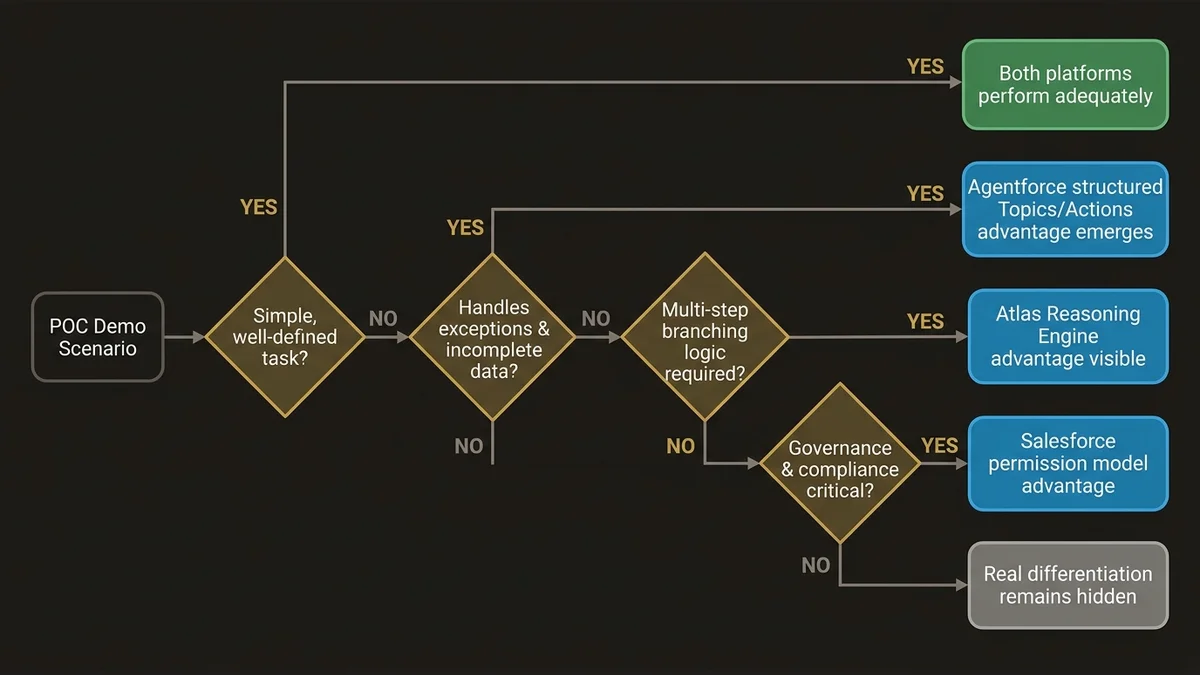
Agentforce’s structured Topics and Actions model forces you to define the scope and behavior of agents explicitly. This feels like overhead during a POC. In production, it is what makes agents reliable and auditable. The Agentforce Testing Center exists precisely because autonomous agents in business processes need to be validated against real scenarios before deployment; not just demoed.
Copilot’s more open-ended generation model feels more impressive in demos because it handles ambiguous prompts gracefully. In production enterprise deployments, that same flexibility becomes a liability when agents need to behave consistently and predictably across thousands of interactions.
The governance question is also underweighted in most evaluations. Agentforce operates inside Salesforce’s permission model; field-level security, sharing rules, and profile-based access all apply to what an agent can see and do. Copilot’s permission model is Microsoft Graph permissions, which is a different security boundary. In regulated industries, the ability to apply your existing CRM governance model to AI agent behavior is not a nice-to-have. It is a compliance requirement.
For organizations already invested in Salesforce’s data architecture, the path to production-grade AI agents is significantly shorter with Agentforce. The Agentforce implementation guide covers the specific configuration sequence that gets agents from concept to production without the common architectural mistakes that cause projects to stall.
If you are evaluating the architectural fit for your specific org, the Agentforce architecture service covers the assessment framework for making that determination based on your actual data model and process complexity.
Key Takeaways
- Agentforce wins on CRM process execution: Its structural advantage is reasoning grounded in live Salesforce data, Data Cloud Unified Individuals, and native Flow orchestration; Copilot cannot replicate this without expensive, fragile connector architecture.
- Copilot wins on enterprise content breadth: Microsoft Graph integration and document-native reasoning make it the right layer for productivity workflows that span email, documents, and communications.
- The Atlas Reasoning Engine is not just an LLM wrapper: It operates inside the Salesforce trust boundary with pre-computed Data Graphs and Calculated Insights, which is architecturally different from Copilot’s external API call model.
- Mature enterprise deployments use both: The correct architecture assigns Agentforce to revenue process execution and Copilot to productivity surface area, with a defined integration boundary between them.
- POC demos are misleading: The real differentiation between platforms appears in exception handling, multi-step branching logic, and governance compliance; none of which show up in a standard demo scenario.
Need help with ai & agentforce architecture?
Design and implement Salesforce Agentforce agents, Prompt Builder templates, and AI-powered automation across Sales, Service, and Experience Cloud.
Related Articles

Agentforce Contact Center Architecture
Agentforce Contact Center shifts CCaaS integration from bolt-on to native. Here's what that means for data flow, AI handoff, and multi-channel scale.

Agentforce RGPD : le vrai défi des DSI
Agentforce Contact Center unifie nativement CRM et IA vocale. Pour les DSI français, cela soulève des questions RGPD et souveraineté données immédiates.

Agentforce ETI : réduire la dette technique
Spring '26 permet aux ETI françaises de moderniser leur Salesforce sans refonte IT. Découvrez comment Agentforce réduit la dette technique en 90 jours.