The Cimulate acquisition doesn’t just add AI merchandising capability to Salesforce’s portfolio. It accelerates a timeline that most enterprise architects were quietly treating as optional. If your Salesforce composable commerce architecture, Cimulate modernization roadmap included, was sitting in a 2027 planning horizon, that horizon just moved.
Here’s the structural problem: Salesforce is now building toward a composable commerce model where AI-driven merchandising, headless storefronts, and unified customer data operate as a coherent system. Cimulate is the merchandising intelligence layer in that system. Orgs still running monolithic B2C Commerce implementations aren’t just missing a feature. They’re accumulating architectural debt against a platform that’s actively moving away from them.
Why Monolith Timelines Were Already Fragile
Most enterprise Commerce Cloud implementations from 2018 to 2022 followed a predictable pattern: SFRA (Storefront Reference Architecture) as the front-end, tightly coupled to Commerce Cloud’s catalog, pricing, and checkout. The logic was sound at the time. SFRA gave teams a structured starting point, and the monolith kept complexity manageable.
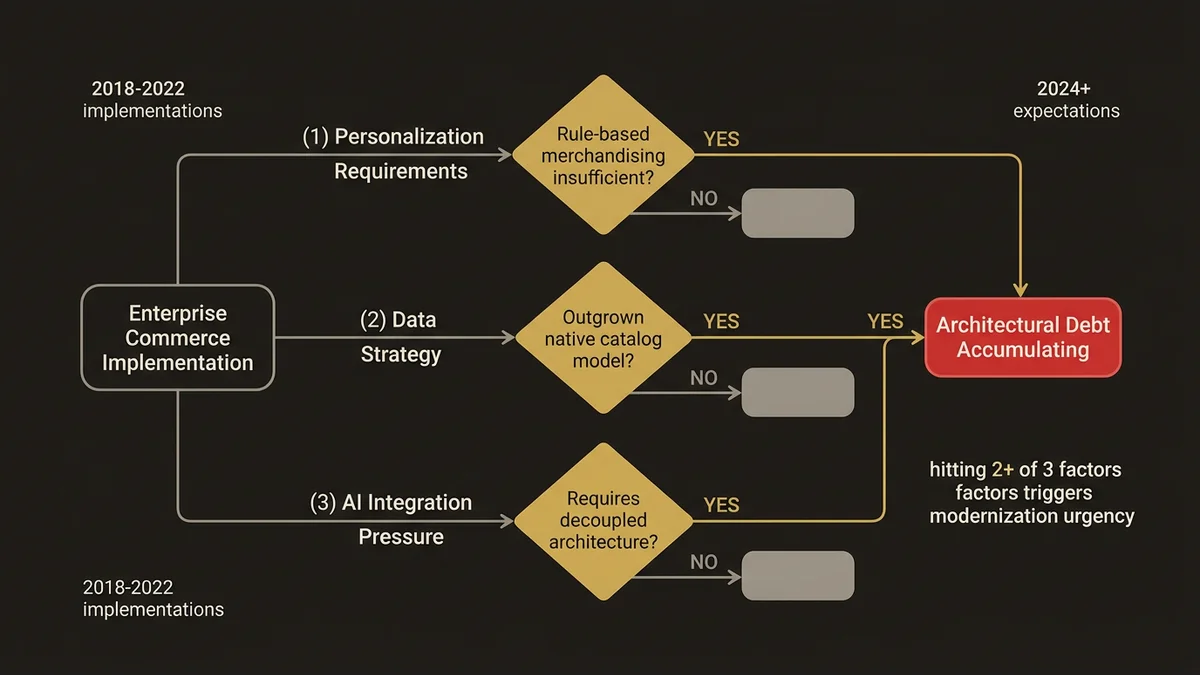
That works until the business needs to move faster than the monolith allows. In practice, the breaking point arrives when three things converge: personalization requirements that exceed what rule-based merchandising can deliver, a data strategy that’s outgrown Commerce Cloud’s native catalog model, and pressure to integrate AI capabilities that assume a decoupled architecture.
Most enterprise orgs hit two of those three by 2024. Cimulate’s acquisition means the third is now arriving as a platform-level expectation, not a future roadmap item.
The architectural implication is direct. Cimulate’s AI merchandising operates most effectively when it can consume unified customer signals from Data Cloud, act on real-time behavioral data, and surface recommendations through a presentation layer that isn’t tightly coupled to Commerce Cloud’s rendering engine. A monolithic SFRA implementation constrains all three of those integration points.
What Composable Commerce Actually Requires Architecturally
Composable commerce is not a front-end pattern. That’s the most common misread. Teams hear “headless” and assume the work is replacing SFRA with a React storefront. The front-end decoupling is the visible part. The architectural work is in the services layer underneath.
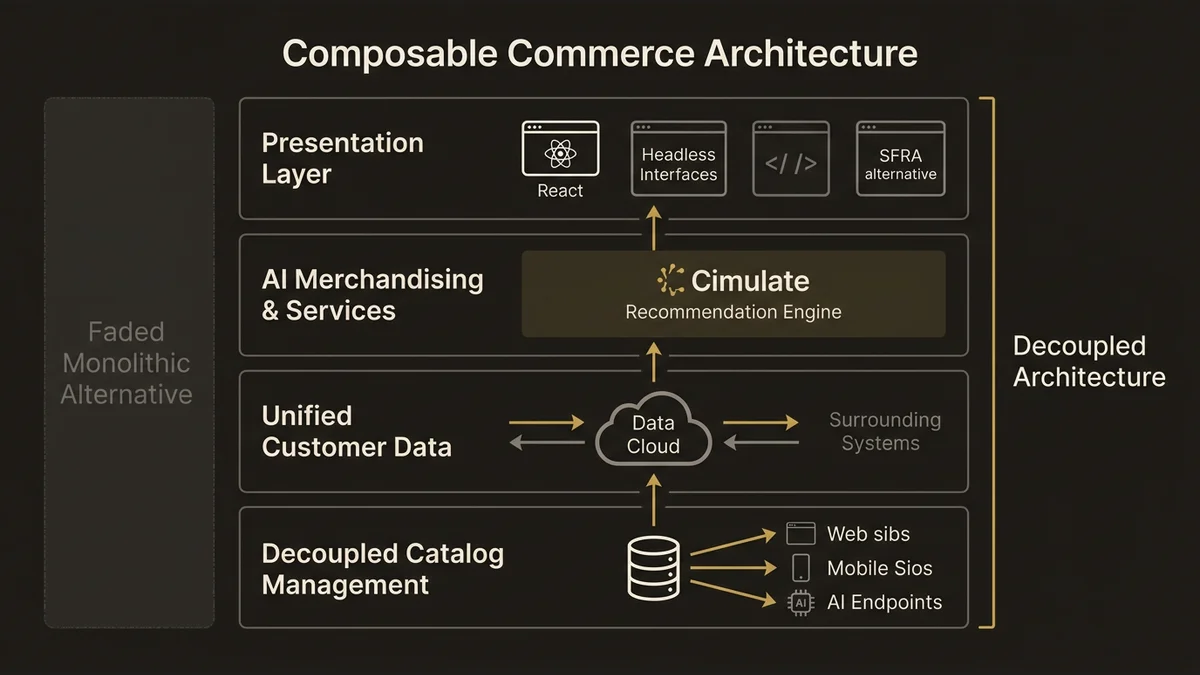
A production-grade Salesforce composable commerce architecture requires four things to function as designed.
Decoupled catalog management. Commerce Cloud’s native catalog works for standard product structures. Once you’re managing complex variant hierarchies, bundled pricing, or AI-generated product content at scale, you need catalog data that can be consumed by multiple surfaces without going through Commerce Cloud’s rendering pipeline. Cimulate’s merchandising layer assumes this separation exists.
Unified customer identity. Cimulate’s AI needs a resolved customer profile to generate meaningful recommendations. That means Data Cloud’s Identity Resolution rulesets need to be producing a Unified Individual that Commerce Cloud, Agentforce, and Cimulate’s models can all reference. Orgs without Data Cloud in their architecture have a gap here that isn’t bridgeable with Commerce Cloud alone.
Event-driven integration. Real-time merchandising decisions require real-time signals. Platform Events or MuleSoft-mediated event streams need to carry behavioral data (browse, cart, abandon) into the AI layer fast enough to influence the current session. Batch integration patterns don’t support this. Monolithic architectures often rely on batch because the storefront and the data layer are the same system.
Headless API surface. Commerce Cloud’s B2C SCAPI (Shopper API) provides the foundation, but composable commerce at scale means additional microservices for pricing, promotions, and inventory that can be called independently. Cimulate’s recommendations need to be injectable at the right point in that API chain, not bolted onto a server-side rendered page.
If your current implementation is missing two or more of these, the Cimulate modernization roadmap isn’t a feature adoption question. It’s a re-architecture question.
How to Assess Your Current Position
The practical starting point is an honest audit of where your architecture sits against those four requirements. Not a theoretical assessment. An actual mapping of data flows, integration patterns, and front-end coupling.
In orgs running monolithic SFRA implementations, the audit typically surfaces three categories of constraint.
The first is rendering coupling. The storefront logic and the business logic are intertwined in controllers and pipelines. Extracting catalog, pricing, or recommendation logic into independent services requires significant refactoring before any AI layer can consume it cleanly.
The second is identity fragmentation. Commerce Cloud maintains its own customer record (the Shopper profile). If that record isn’t synchronized with a unified Data Cloud profile, Cimulate’s AI is working with incomplete behavioral history. The recommendations degrade. The business case for the AI investment weakens.
The third is integration latency. Many Commerce Cloud implementations use scheduled data exports or nightly sync jobs to move data between systems. That’s incompatible with session-level personalization. The integration layer needs to be rebuilt around events before the AI layer can operate at the latency it requires.
The assessment framework I’d apply here maps directly to the Salesforce architecture review checklist approach: identify the constraint, quantify the gap, sequence the remediation. The difference with composable commerce is that the sequencing is now time-pressured by Salesforce’s own product direction.
Sequencing the Modernization Without a Full Rewrite
The wrong response to this situation is a big-bang rewrite. Replacing a production Commerce Cloud monolith in a single program is high-risk and rarely necessary. The right response is a sequenced decomposition that prioritizes the integration points Cimulate and Agentforce actually need.
The sequence that survives in practice looks like this.
Start with identity. Get Data Cloud’s Identity Resolution producing a Unified Individual that includes Commerce behavioral data. This is the foundational dependency for everything else. Without a resolved customer profile, AI merchandising is guessing. This phase typically takes 90 to 120 days in orgs that already have Data Cloud licensed and partially implemented.
Second, instrument the event layer. Stand up Platform Events or a MuleSoft event bus to carry real-time behavioral signals out of the storefront and into Data Cloud. This doesn’t require touching the storefront’s rendering logic. It’s an instrumentation layer on top of existing SFRA controllers. The storefront stays intact. The data starts flowing in real time.
Third, expose catalog and pricing as independent APIs. This is where the actual decomposition begins. Extract catalog management into a service that can be called by the storefront, by Cimulate’s merchandising layer, and by any future headless front-end. Commerce Cloud’s SCAPI provides a starting point, but complex orgs will need additional abstraction for pricing and promotion logic.
Fourth, introduce the AI layer. Once identity is resolved, events are flowing, and catalog is accessible via API, Cimulate’s merchandising intelligence has the inputs it needs to operate effectively. Agentforce agents can be configured with Topics and Actions that reference the same unified profile and catalog APIs. The AI layer becomes additive rather than disruptive.
This sequence matters because it keeps the production storefront running throughout. The business doesn’t absorb a rewrite risk. The architecture moves toward composable incrementally, with each phase delivering standalone value.
For orgs with significant technical debt in their Commerce Cloud implementation, the org health recovery work often needs to precede this sequence. Decomposing a monolith that has years of undocumented customizations requires a cleanup phase first. Skipping it means the decomposition inherits the debt.
The Timeline Pressure Is Real
Salesforce’s product investment follows its acquisition strategy. Cimulate’s capabilities will be integrated into the Commerce Cloud and Agentforce roadmap. The features that arrive first will be designed for composable architectures. Monolithic implementations will get them later, in degraded form, or not at all.
This is the pattern that played out with Data Cloud. Orgs that had already decoupled their data layer got real-time activation and Calculated Insights as first-class capabilities. Orgs still running batch ETL into Marketing Cloud got a migration project instead of a feature.
The current decision determines whether your org is in the first group or the second when Cimulate’s AI merchandising reaches general availability. Architects who treat composable commerce as a 2027 initiative are making a bet that Salesforce’s integration timeline is slower than it historically has been. That’s not a bet I’d take.
The 18-month window is the realistic planning frame. Orgs that start the identity and event-layer work now will have the architectural foundation in place when Cimulate’s capabilities are production-ready. Orgs that wait for a complete product announcement before starting will be 12 to 18 months behind on the foundational work, regardless of how fast they move after that.
Key Takeaways
- The Cimulate acquisition makes composable commerce a near-term architectural requirement, not a future-state aspiration. Monolithic SFRA implementations are now accumulating debt against Salesforce’s active product direction.
- Composable commerce architecture requires four specific capabilities: decoupled catalog management, unified customer identity via Data Cloud, event-driven integration for real-time signals, and a headless API surface. Missing two or more means re-architecture, not feature adoption.
- The correct modernization sequence starts with identity resolution, then event instrumentation, then catalog API extraction, then AI layer introduction. This keeps production systems running throughout and delivers value at each phase.
- Orgs without Data Cloud’s Identity Resolution producing a Unified Individual have a foundational gap that Cimulate’s AI merchandising cannot work around. That gap needs to close before any AI merchandising investment makes sense.
- The 18-month planning frame is the operative window. Architectural decisions made now determine whether your org receives Cimulate’s capabilities as first-class features or as a migration project.
Need help with ai & agentforce architecture?
Design and implement Salesforce Agentforce agents, Prompt Builder templates, and AI-powered automation across Sales, Service, and Experience Cloud.
Related Articles

Agentforce Operations: Architecture Guide
Agentforce Operations redefines back-office automation. Here's the architectural blueprint for deterministic agent control planes at enterprise scale.

Salesforce Prompt Builder : bonnes pratiques
Prompt Builder mal configuré = agents Agentforce imprévisibles. Les bonnes pratiques architecturales pour éviter les pièges les plus coûteux.

Salesforce AI Specialist Cert Prep 2026
The Salesforce AI Specialist certification in 2026 tests architecture judgment, not recall. Here's how to prepare for what the exam actually measures.