
Salesforce completed its acquisition of Momentum on March 2, 2026, integrating its capabilities directly into Agentforce 360 and Slack. The salesforce momentum acquisition agentforce integration path determines whether revenue teams get a unified reasoning layer or another data source bolted onto an already fragmented stack. That distinction determines whether revenue teams get a different class of system or just another reporting tab.
The Problem Momentum Was Built to Solve
Momentum captures what happens in sales conversations: commitments made, objections raised, next steps agreed, deal risks surfaced. It structures the unstructured. A 45-minute discovery call becomes a set of signals that a CRM record never captures on its own.
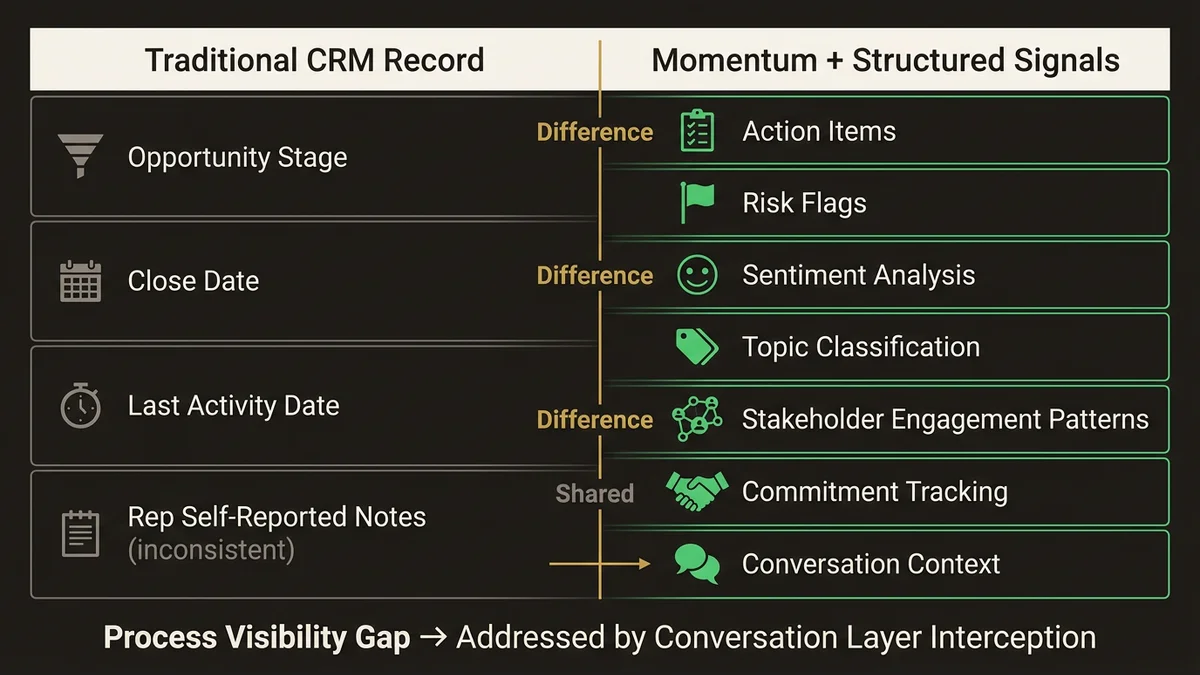
The gap Momentum addresses is not a data gap. It’s a process visibility gap. Sales leaders know their pipeline numbers. They rarely know why deals move or stall at the conversation level. Traditional CRM hygiene depends on rep self-reporting, which is inconsistent by design. Reps optimize for closing, not for logging.
What Momentum does architecturally is intercept the conversation layer and produce structured outputs: action items, risk flags, sentiment signals, topic classification. These outputs are valuable in isolation. Inside an Agentforce reasoning context, they become something different. They become grounded evidence for agent decisions.
How Conversational Signals Fit the Agentforce Architecture
The Atlas Reasoning Engine operates on context. The quality of an agent’s output is bounded by the quality of its grounding data. A Sales Agent tasked with identifying at-risk deals can only reason as well as the signals it has access to. If those signals are limited to Opportunity stage, close date, and last activity date, the agent’s conclusions will be shallow.
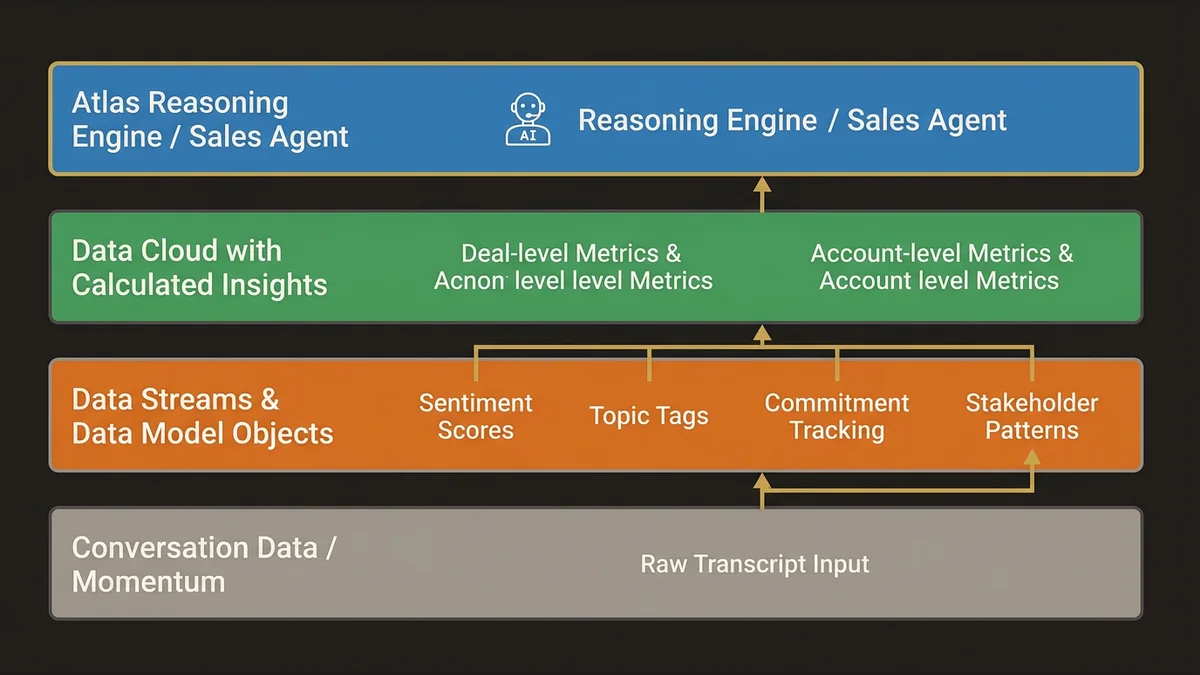
Momentum’s universal ingestion engine, now part of the Agentforce 360 platform, extends this grounding surface beyond Salesforce-native channels. Conversation signals from Zoom, Google Meet, and other third-party voice and video platforms flow into the same structured pipeline as native call recordings. That matters architecturally because most enterprise sales motions do not happen exclusively inside Salesforce-connected channels. The “patchy enterprise data” problem, where Agentforce agents reasoned well against CRM data but had no visibility into external conversation channels, is what this acquisition directly addresses.
A deal where the economic buyer stopped engaging three calls ago reads differently than a deal where they asked about implementation timelines last week. That distinction exists in the conversation data. It has never reliably existed in the CRM record.
The architectural integration path has three layers to get right.
Ingestion. Momentum’s conversation outputs need to flow into Data Cloud via Data Streams. Raw transcript data is not the target. Structured signals are: sentiment scores, topic tags, commitment tracking, stakeholder engagement patterns. These map cleanly to Data Model Objects and can be joined against Account, Opportunity, and Contact records through Data Graphs. The identity resolution layer matters here. Conversation participants need to resolve to Unified Individuals, not just email strings, or the join quality degrades at scale.
Calculated Insights. Once conversation signals are in Data Cloud, Calculated Insights can compute deal-level and account-level metrics: engagement velocity, topic drift over time, stakeholder coverage gaps. These become profile attributes that Agentforce agents can read directly. A Revenue Intelligence Agent checking deal health pulls a Calculated Insight, not a raw transcript.
Agent Actions. The final layer is what the agent does with the signal. An Agentforce Action triggered by a deal risk flag might update the Opportunity, create a follow-up task, surface a coaching recommendation to the manager, or escalate to a human. The action design determines whether the integration produces value or noise. Most implementations get this wrong by creating too many actions with insufficient scoping. The Topics and Instructions layer needs to constrain agent behavior tightly, especially in revenue-critical workflows.
Where Enterprise Orgs Will Get This Wrong
A common pattern in enterprise orgs is to treat an acquisition like this as a data integration project. The team connects Momentum outputs to Salesforce, builds a few reports, and declares success. That approach misses the architectural opportunity entirely.
The deeper failure mode is silo replication. Momentum data lands in Salesforce but stays isolated: a set of custom objects or a managed package that sits adjacent to the core data model rather than integrated into it. Sales reps get a new tab. Agents get no new grounding. The conversation layer remains disconnected from the reasoning layer.
The architecture that survives this integration is one where Momentum signals are treated as first-class Data Cloud entities from day one. Not a CRM extension. Not a reporting layer. A set of normalized, identity-resolved, insight-ready data points that the entire Agentforce surface can consume.
That requires decisions made early. Which conversation signals are architecturally significant? What is the canonical data model for a “conversation event” in your org? How do you handle signal latency? Momentum data arriving 24 hours after a call is useful for coaching. It is not useful for real-time agent reasoning during an active deal cycle. The ingestion pipeline design needs to reflect that distinction.
Orgs with 3,000+ active opportunities in pipeline will also face a volume problem. Every conversation generates signals. Not every signal is architecturally relevant. The Calculated Insights layer needs to do real work here: aggregating, filtering, and surfacing only the signals that change the agent’s decision surface. Feeding raw conversation data into agent context windows is a governor limit problem waiting to happen.
Revenue Orchestration Beyond the Sales Cloud Boundary
The harder architectural question is what happens when Momentum signals cross the Sales Cloud boundary.
A deal that closes creates downstream obligations: implementation timelines, service commitments, product configurations. Those obligations live in Service Cloud, Commerce Cloud, and external systems. The conversation where those commitments were made lives in Momentum. Today, those two facts exist in separate systems with no structural connection.
Agentforce 360 is the orchestration layer that can close that gap. With Momentum’s ingestion engine now native to the platform, an agent with access to both the conversation record and the downstream fulfillment state can identify misalignment before it becomes a customer escalation. A commitment made in a sales call that conflicts with what was actually provisioned is a chargeable problem in enterprise accounts. Catching it at the agent reasoning layer, before the customer notices, is a different class of value than any reporting dashboard provides. The Slack integration extends this further: Momentum-derived signals can surface directly in deal rooms and account channels, routing context to the right human without requiring a CRM lookup.
This is where MuleSoft becomes relevant. Momentum signals flowing into Data Cloud cover the Salesforce-native surface. External systems, ERP, CPQ, provisioning platforms, need MuleSoft integration to surface their state into the same reasoning context. The architecture that works here treats Data Cloud as the semantic layer and MuleSoft as the connectivity layer. Agents reason against Data Cloud. MuleSoft keeps Data Cloud current.
The orchestration pattern that emerges is: conversation signal triggers Calculated Insight update, Calculated Insight triggers Agentforce evaluation, Agentforce agent reasons across Sales Cloud, Service Cloud, and external system state, agent action either resolves the issue autonomously or routes to a human with full context. That is a materially different capability than a sales dashboard with a Momentum widget.
What to Build First
The integration roadmap has a clear sequencing logic. Get the data architecture right before building agent behaviors. Agent behaviors built on a weak data foundation will produce unreliable outputs, and unreliable outputs in revenue workflows destroy adoption faster than any technical failure.
Start with Data Streams. Define the canonical Momentum event schema, accounting for signals from both native Salesforce channels and third-party sources like Zoom and Google Meet now that the universal ingestion engine is part of the platform. Map it to existing DMOs. Run identity resolution against the Contact and Account graph. Validate match rates before moving forward. In orgs with inconsistent CRM hygiene, identity resolution match rates below 80% indicate a data quality problem that will corrupt every downstream agent decision.
Once the data layer is stable, build Calculated Insights for the three or four signals that actually change deal outcomes in your specific sales motion. Engagement velocity. Economic buyer coverage. Commitment-to-action ratio. These will vary by org. The mistake is building twenty Calculated Insights before validating that any of them correlate with deal outcomes in your pipeline.
Then scope the first agent narrowly. A deal risk identification agent with read-only behavior and human-in-the-loop escalation is the right starting point. It builds trust in the signal quality before any autonomous action is taken. Use the Agentforce Testing Center to validate reasoning paths against historical deal data before going live.
The full revenue orchestration vision, agents that act across Sales, Service, and external systems based on conversation signals, is an 18-month build at enterprise scale. The architecture that gets you there starts with a 90-day data foundation sprint, not an agent sprint.
Key Takeaways
- Closed March 2, 2026. The universal ingestion engine pulls structured conversation signals from Zoom, Google Meet, and other third-party channels, not just Salesforce-native sources.
- Route Momentum through Data Cloud Data Streams into normalized DMOs. Resolve against Unified Individuals, surface as Calculated Insights. Custom objects on Sales Cloud is not the architecture.
- Treat signal latency as a design constraint. Real-time reasoning and async coaching require different ingestion pipelines.
- MuleSoft is the connectivity layer; Data Cloud is the semantic layer. Agents reason against Data Cloud, never against external systems directly.
- If you start with agent design before validating signal quality, you rebuild the data layer six months later under pressure. Sequence: data, Calculated Insights, narrow agent.
The acquisition gives Salesforce a conversation layer it did not have. Whether enterprise orgs extract architectural value from it depends on decisions made in the next 90 days, before the managed package gets installed and the integration gets treated as done.
For teams evaluating how this fits into an existing Agentforce or Data Cloud architecture, the AI and Agentforce Architecture and Data Cloud and Multi-Cloud Architecture service pages outline the engagement patterns that apply here.
Need help with ai & agentforce architecture?
Design and implement Salesforce Agentforce agents, Prompt Builder templates, and AI-powered automation across Sales, Service, and Experience Cloud.
Related Articles

Agentforce Operations: Architecture Guide
Agentforce Operations redefines back-office automation. Here's the architectural blueprint for deterministic agent control planes at enterprise scale.

Salesforce Prompt Builder : bonnes pratiques
Prompt Builder mal configuré = agents Agentforce imprévisibles. Les bonnes pratiques architecturales pour éviter les pièges les plus coûteux.

Salesforce AI Specialist Cert Prep 2026
The Salesforce AI Specialist certification in 2026 tests architecture judgment, not recall. Here's how to prepare for what the exam actually measures.