
Salesforce conversation data governance compliance was already a hard problem before Momentum entered the picture. Now it’s harder. Real-time conversation intelligence doesn’t just add a new data type; it fundamentally changes the risk surface of your Salesforce org.
Most post-acquisition coverage has focused on the API integration layer: how conversation objects map to Salesforce’s core data model, where the schema friction lives. That’s a real problem, but it’s the wrong place to start. The governance and compliance exposure that Momentum’s architecture introduces is more consequential and less visible. It’s the kind of risk that surfaces during a regulatory audit or a data subject access request, not during a sprint review.
Why Conversation Data Is a Different Compliance Category
Structured CRM data; contacts, opportunities, activity logs; has a well-understood governance posture. You know what’s in it, you can classify it, you can apply retention policies and access controls with reasonable confidence. Conversation data is categorically different.
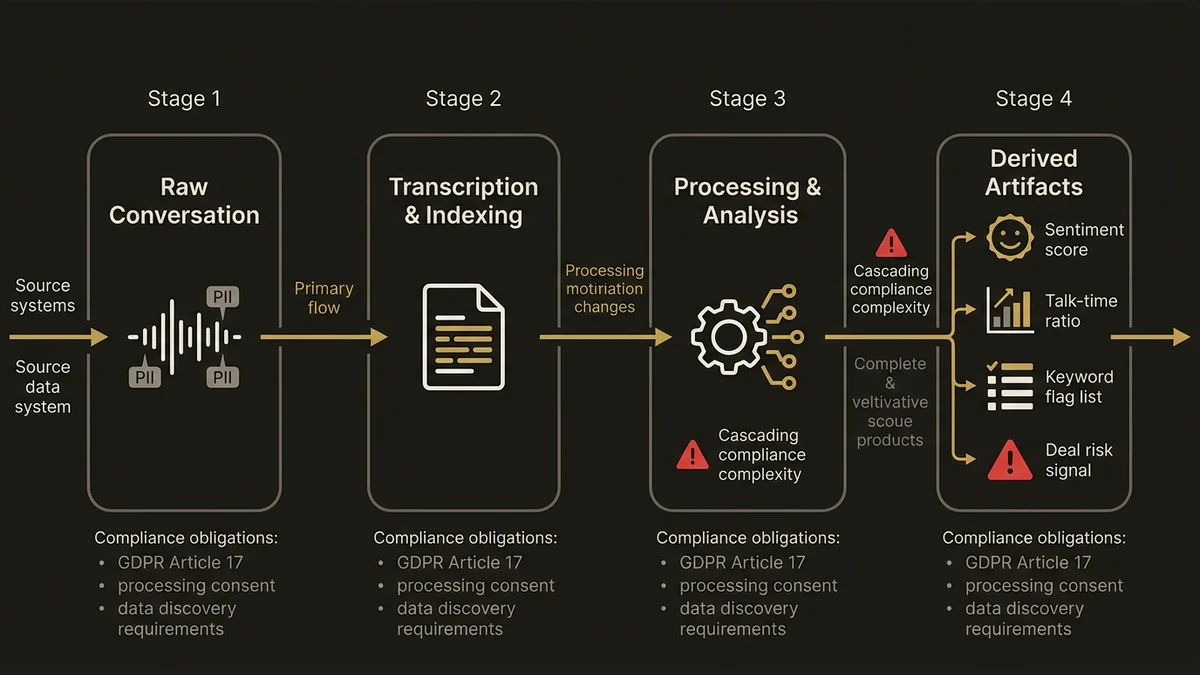
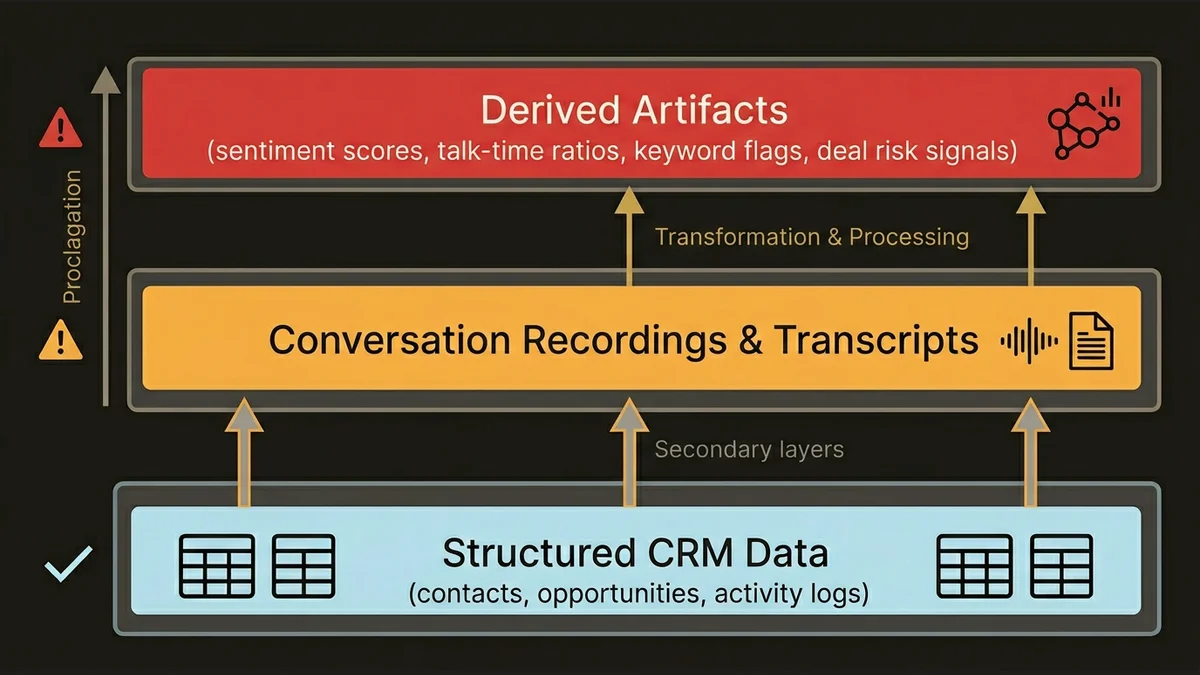
A recorded sales call contains spoken PII that isn’t tagged, structured, or discoverable through standard Salesforce data classification tools. It may include references to third parties who never consented to being recorded. It captures negotiation context, pricing discussions, and competitive intelligence in a form that’s legally discoverable. Under GDPR Article 17, a data subject can request erasure of any personal data; and “I can’t find it in the transcript index” is not a compliant response.
Momentum’s real-time intelligence layer compounds this. The platform doesn’t just store recordings; it generates derived artifacts: sentiment scores, talk-time ratios, keyword flags, deal risk signals. Each of these is a processed output derived from personal data. Under GDPR’s definition of processing, each derived artifact carries its own compliance obligation. You’re not managing one data asset; you’re managing a cascade of them, most of which don’t have a natural home in Salesforce’s standard data model.
The architecture that works here treats conversation data and its derivatives as a distinct data classification tier, not as an extension of activity data.
Where Salesforce’s Native Governance Falls Short
Salesforce’s platform governance capabilities are strong for what they were designed to handle. Field-level security, sharing rules, platform encryption, and Data Mask cover structured CRM data well. They don’t cover unstructured conversation artifacts.
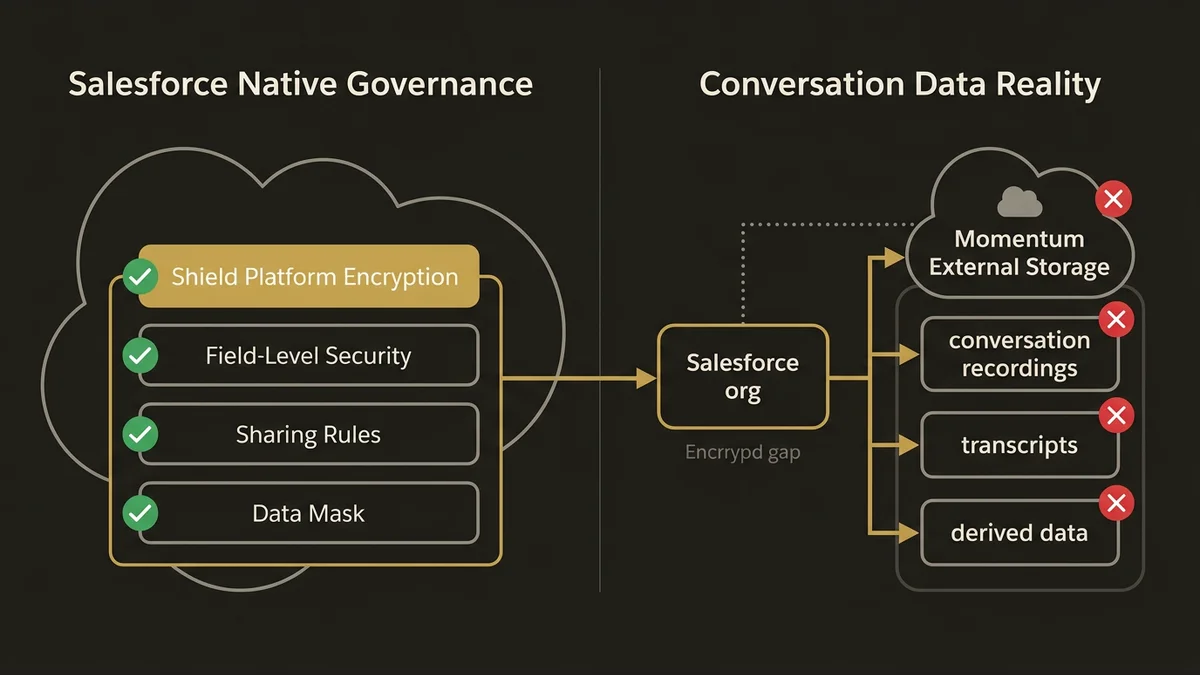
Shield Platform Encryption can encrypt fields and files, but it operates at the Salesforce storage layer. If Momentum’s conversation recordings and transcripts live in an external storage system; which is the common pattern for large audio files; Shield doesn’t touch them. The encryption posture for those assets is entirely dependent on Momentum’s own infrastructure, which is now a Salesforce infrastructure question post-acquisition, but not one that’s been publicly resolved.
Data Cloud adds another layer of complexity. In orgs where conversation data flows into Data Cloud via Data Streams, the Identity Resolution process will attempt to unify conversation participants against the Unified Individual profile. That’s architecturally useful; it’s how you get a complete Customer 360 view that includes conversation history. But it also means that conversation-derived attributes (sentiment, engagement score, objection patterns) become part of the unified profile. Those attributes are now subject to the same data subject rights as any other profile data, and they’re significantly harder to explain to a regulator than a contact record.
The Calculated Insights layer in Data Cloud can compute profile-level metrics from conversation data. Once those insights are materialized, they persist independently of the source conversation. If the source recording is deleted in response to a right-to-erasure request, the derived insight may still exist. That’s a compliance gap that requires explicit architectural handling; not a configuration checkbox.
Building a Compliant Conversation Data Architecture
The governance architecture that addresses this has four components that must be designed together, not bolted on sequentially.
Consent and lawful basis tracking needs to happen at the point of conversation capture, not retroactively. For Momentum-integrated orgs, this means establishing a consent record in Salesforce that links to each conversation artifact before that artifact is processed. In practice, this is a custom object or a Data Cloud DMO that captures the recording consent status, jurisdiction, and applicable legal basis. Without this, you cannot demonstrate lawful processing under GDPR Article 6 for any conversation-derived data.
Data lineage from conversation to derived artifact is the second requirement. Every Calculated Insight, sentiment score, or AI-generated summary that originates from a conversation needs a traceable link back to the source recording and the consent record. This is not a native Data Cloud capability; it requires explicit design in the Data Stream configuration and the DMO schema. The lineage chain has to survive the deletion of the source asset, which means the lineage record itself needs a retention policy that outlasts the conversation data.
Erasure propagation is where most implementations will fail. A right-to-erasure request triggers deletion of the source recording, the transcript, and every derived artifact. In a Momentum-integrated architecture, those artifacts may exist in Salesforce CRM (activity records, call summaries), Data Cloud (unified profile attributes, Calculated Insights), Agentforce context (if conversation summaries have been used as grounding data in Prompt Builder templates), and Momentum’s own storage layer. Coordinating erasure across all four systems requires an orchestration layer; Flow alone won’t cover it. Platform Events can trigger the cascade, but the external system deletions require MuleSoft or an equivalent integration layer with confirmed deletion receipts.
Access control for conversation artifacts needs to be more granular than standard Salesforce sharing. A conversation recording may be accessible to the account owner, the sales manager, and the revenue operations team; but not to a customer success rep who later inherits the account. Standard role hierarchy sharing doesn’t model this well. The architecture that works here uses a combination of sharing rules scoped to conversation record type and a custom permission set that gates access to conversation-derived fields separately from the underlying opportunity or contact record.
For a deeper look at how Agentforce’s reasoning layer interacts with sensitive data in these architectures, the Agentforce agent design patterns for enterprise article covers the grounding data governance considerations in detail.
The Regulatory Exposure That’s Being Underestimated
GDPR is the obvious framework, but it’s not the only one. CCPA’s definition of “sensitive personal information” includes communications content, which means conversation recordings and transcripts likely qualify. The California Privacy Rights Act gives consumers the right to limit the use of sensitive personal information; a right that’s difficult to honor if conversation data is deeply embedded in a unified profile and used as grounding context for AI-generated outputs.
In regulated industries, the exposure is more acute. Financial services firms using Momentum for sales call intelligence face MiFID II requirements around communication recording and retention that conflict with GDPR’s data minimization principle. Healthcare-adjacent orgs need to evaluate whether conversation data captured during sales calls constitutes PHI under HIPAA if the conversation references a prospect’s health situation. These aren’t edge cases; they’re predictable scenarios in any enterprise deployment.
The forward-looking risk is Agentforce. As Momentum’s conversation intelligence gets surfaced through Agentforce actions and used as context in the Atlas Reasoning Engine’s decision-making, conversation-derived data becomes part of AI-generated outputs. Those outputs may be presented to customers, used in automated decisions, or stored as new records. At that point, the compliance obligation extends to the AI output layer, not just the source data. The EU AI Act’s transparency requirements for high-risk AI systems will apply to automated decisions that are informed by conversation intelligence, and “the data came from Momentum” is not a sufficient audit trail.
Orgs that are serious about this should be reviewing their Salesforce Data Cloud implementation architecture now, before conversation data is fully integrated into the unified profile and the remediation cost becomes prohibitive.
The Governance Decision That Can’t Wait
The window for getting this right is narrow. Once conversation data is flowing into Data Cloud, unified into the Unified Individual profile, and surfaced through Agentforce actions, the architectural debt compounds quickly. Retrofitting consent tracking, lineage, and erasure propagation into a live system is significantly more expensive than designing for it upfront.
The concrete next step is a data classification audit scoped specifically to conversation artifacts and their derivatives. Map every place a Momentum-originated data point lands in your Salesforce ecosystem; CRM records, Data Cloud DMOs, Calculated Insights, Prompt Builder templates, Agentforce action outputs. For each landing point, document the retention policy, the access control model, and the erasure path. That map is the foundation of a defensible compliance posture.
If that map doesn’t exist yet, the compliance risk is already present. The acquisition made it Salesforce’s problem. It’s also yours.
Key Takeaways
- Conversation recordings and their AI-derived artifacts (sentiment scores, summaries, risk signals) are distinct compliance categories under GDPR, CCPA, and sector-specific regulations; treating them as activity data is a governance failure waiting to happen.
- Salesforce Shield Platform Encryption does not cover conversation artifacts stored in external systems; the encryption posture for Momentum’s audio and transcript storage is an open architectural question post-acquisition.
- Calculated Insights derived from conversation data persist independently of the source recording, creating a compliance gap where right-to-erasure requests on the source asset leave derived data intact unless explicitly handled.
- Erasure propagation across Salesforce CRM, Data Cloud, Agentforce grounding context, and Momentum’s storage layer requires an orchestrated integration approach; Platform Events plus MuleSoft with confirmed deletion receipts, not Flow alone.
- The EU AI Act’s transparency requirements will extend compliance obligations to Agentforce outputs that are informed by conversation intelligence, making the governance architecture a prerequisite for compliant AI deployment, not an afterthought.
Need help with ai & agentforce architecture?
Design and implement Salesforce Agentforce agents, Prompt Builder templates, and AI-powered automation across Sales, Service, and Experience Cloud.
Related Articles

Agentforce Operations: Architecture Guide
Agentforce Operations redefines back-office automation. Here's the architectural blueprint for deterministic agent control planes at enterprise scale.

Salesforce Prompt Builder : bonnes pratiques
Prompt Builder mal configuré = agents Agentforce imprévisibles. Les bonnes pratiques architecturales pour éviter les pièges les plus coûteux.

Salesforce AI Specialist Cert Prep 2026
The Salesforce AI Specialist certification in 2026 tests architecture judgment, not recall. Here's how to prepare for what the exam actually measures.