
The salesforce spring 26 release is not a feature drop. It’s a structural shift in how Agentforce agents interact with CRM data, external systems, and real-time voice channels. If you’re treating it as a changelog to skim, you’re already behind on the architectural decisions it forces.
Four capabilities deserve serious attention: Agentforce Sales Workspace, Proactive Service agents, voice capabilities for Financial Services Cloud, and always-on prospecting. Each one touches a different layer of your data model or integration topology. Together, they introduce a stack of new dependencies, data model conflicts, routing topology changes, and compliance obligations, that most orgs aren’t positioned to absorb cleanly in a single release cycle.
What Agentforce Sales Workspace Actually Changes in Your Data Model
Sales Workspace isn’t a UI refresh. It’s an opinionated restructuring of how the Atlas Reasoning Engine surfaces context to sales agents, and that opinion has consequences for your object model.
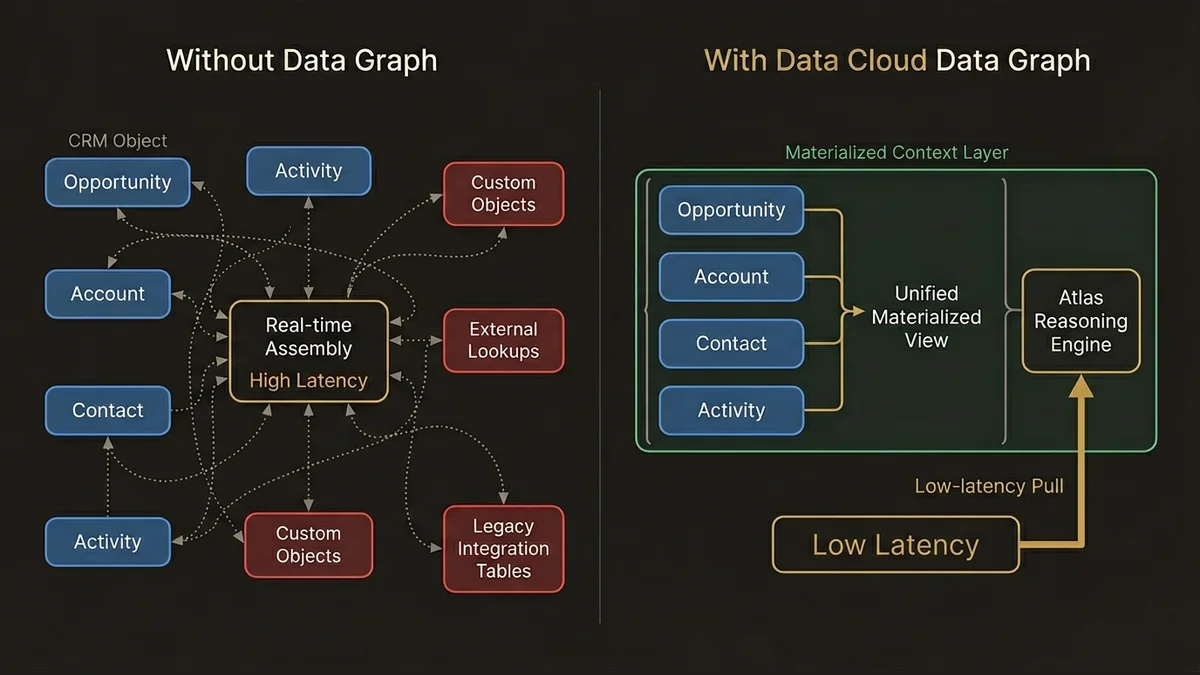
The workspace consolidates signals from Opportunity, Account, Contact, and Activity into a unified agent context window. In practice, this means the reasoning engine needs pre-joined, low-latency access to relationship data that most enterprise orgs have spread across custom objects, external lookups, and legacy integration tables. If your Account hierarchy lives partly in a custom Account_Hierarchy__c structure or your activity data is synced from an external calendar system via MuleSoft, the agent’s context assembly becomes expensive and brittle.
The architecture that works here is a Data Graph in Data Cloud. Pre-computing the joins between Unified Individual profiles, Account relationships, and Calculated Insights on engagement velocity means the Atlas Reasoning Engine pulls from a materialized view rather than assembling context at query time. Orgs that skip this step will see degraded agent response quality and latency spikes during peak usage, not because the agent is misconfigured, but because the data substrate isn’t built for real-time reasoning.
One specific pattern to watch: Sales Workspace exposes a “next best action” surface that draws on Agentforce Actions. If those Actions invoke External Services to pull in third-party firmographic or intent data, you need explicit caching logic. Calling an external enrichment API synchronously on every workspace load is an architectural mistake that will surface as a performance problem at scale.
Proactive Service Agents and the Routing Logic Problem
Proactive Service is the capability that will generate the most architectural debt if deployed carelessly. The premise is sound: agents initiate outreach based on detected signals rather than waiting for inbound cases. The implementation risk is in how those signals connect to your existing routing infrastructure.
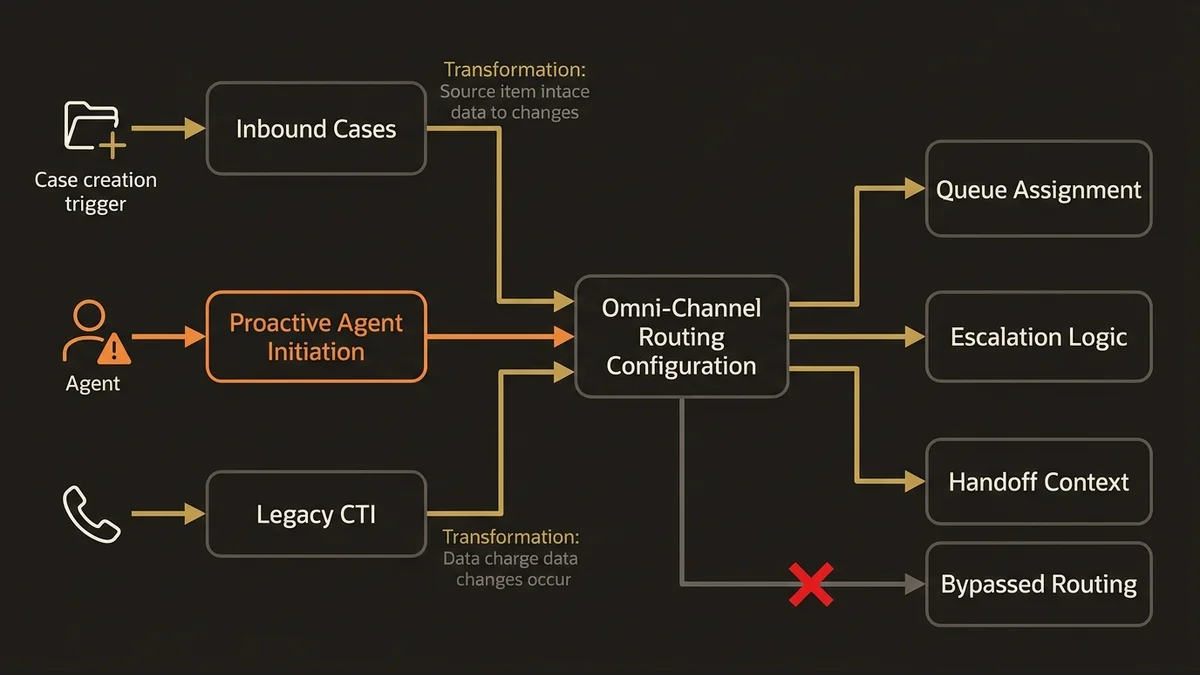
Most enterprise service orgs have routing logic distributed across Omni-Channel flow configurations, custom Flow orchestrations, and sometimes legacy CTI middleware. Proactive agents introduce a new initiation path that bypasses the traditional case creation trigger. If your routing rules assume a case record exists before assignment decisions are made, proactive outreach will either skip routing entirely or create orphaned interactions with no queue ownership.
The fix requires treating proactive agent initiation as a first-class routing event. That means extending your Omni-Channel configuration to handle agent-initiated work items, not just inbound ones. It also means your escalation logic needs to account for the scenario where a proactive agent surfaces a complex issue mid-conversation that requires human handoff. The handoff context, including the full conversation transcript and the signal that triggered outreach, must be passed cleanly to the receiving agent’s workspace.
In orgs running at significant service volume, the routing topology change is non-trivial. Proactive Service effectively adds a new work item source that your capacity planning models don’t currently account for. Deploy this without updating your Omni-Channel routing configuration and you’ll create queue imbalances that are hard to diagnose because the source isn’t visible in standard reporting.
The Agentforce agent design patterns for enterprise article covers the structural routing and escalation decisions that apply directly here.
Voice Capabilities for Financial Services: The Compliance Layer Is the Architecture
Salesforce’s voice capabilities for Financial Services Cloud in Spring ‘26 are genuinely useful. They’re also the feature most likely to create regulatory exposure if the data architecture isn’t built correctly before go-live.
Voice interactions in regulated financial services environments generate data that falls under multiple compliance frameworks simultaneously: call recording retention requirements, PII handling obligations, and in many jurisdictions, specific rules around AI-generated advice or recommendations delivered verbally. The architectural question isn’t whether to enable voice agents. It’s whether your Data Cloud configuration can enforce the right data handling policies on voice-derived data from the moment of ingestion.
Voice transcripts ingested via Data Streams need classification at the DMO level. Specifically, you need to distinguish between transcript segments that contain regulated financial information and those that don’t, because retention policies, access controls, and deletion workflows differ. Applying a single data handling policy to the entire transcript is the wrong approach and will create compliance gaps that surface during audit.
The Identity Resolution layer adds another dimension. Voice interactions need to be resolved to a Unified Individual profile, but the matching ruleset for voice-derived identifiers (phone numbers, voice biometrics if enabled) requires different confidence thresholds than email or cookie-based matching. Setting the same fuzzy match tolerance across all identifier types is a common mistake that produces false merges in financial services contexts. A concrete example: a husband and wife sharing a household landline both call the wealth management line. With email-grade fuzzy matching applied to phone, the Unified Individual collapses into a single profile, and the agent surfaces the husband’s investment portfolio context to the wife’s call. That’s a regulated-data exposure and a relationship-trust failure in one event.
Orgs in this space should also be explicit about where voice-derived Calculated Insights are stored and who can query them. A calculated insight that reflects a customer’s expressed investment risk tolerance, derived from a voice conversation, is sensitive data that requires access governance beyond standard field-level security.
Always-On Prospecting and the External Data Integration Trap
Always-on prospecting is the Spring ‘26 capability that sounds most straightforward and carries the most hidden integration complexity.
The feature enables Agentforce to continuously monitor signals, both internal CRM signals and external intent data, and trigger prospecting actions without a human initiating the workflow. The internal signal monitoring is manageable. The external data integration is where architectures break.
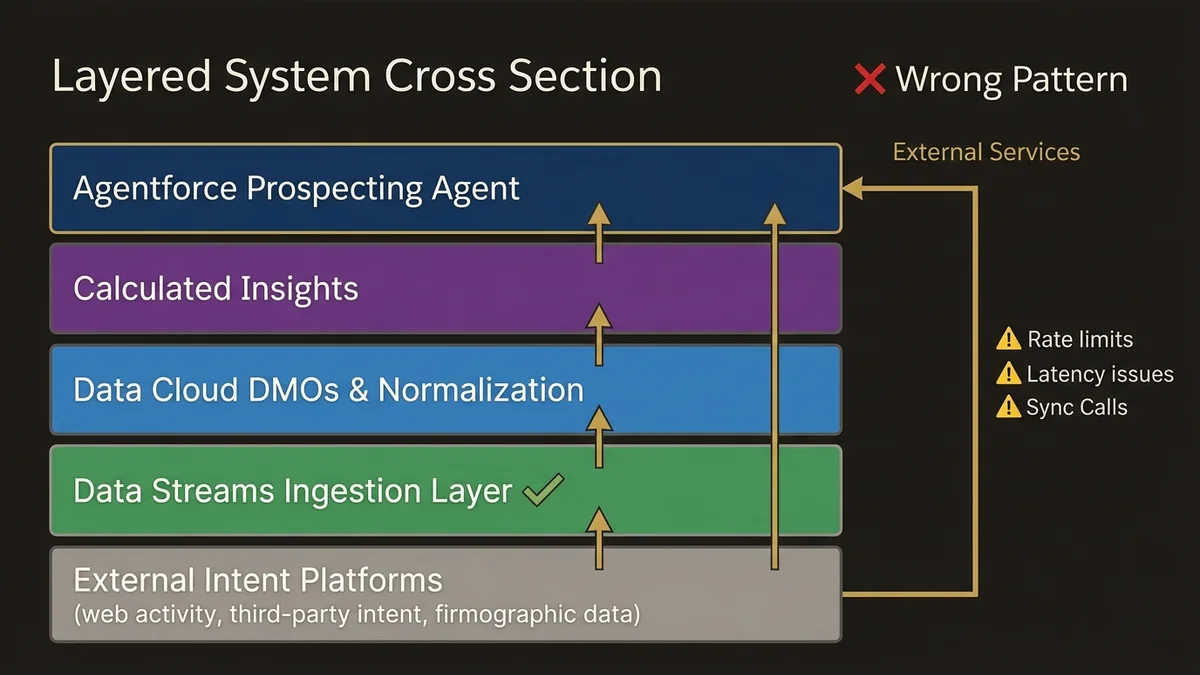
In practice, always-on prospecting requires a reliable, low-latency feed of external intent signals: web activity, third-party intent platforms, firmographic change events. The temptation is to wire these directly into Agentforce Actions via External Services calls. That’s the wrong pattern for continuous monitoring. External Services are designed for synchronous, request-response interactions triggered by a specific event. Polling an external intent platform via External Services on a continuous basis creates rate limit exposure, unpredictable latency, and no buffering if the external system degrades.
The correct architecture uses Data Cloud Data Streams as the ingestion layer for external signals. Intent data arrives via streaming or batch Data Streams, gets normalized into DMOs, and feeds Calculated Insights that the prospecting agent reads from. The agent never calls the external system directly. This decoupling means external system degradation doesn’t cascade into agent failures, and you have a single place to govern data quality and freshness for all prospecting signals.
There’s a secondary issue with always-on prospecting that most orgs discover too late: the agent needs a suppression list mechanism. Without explicit logic to prevent re-engagement with contacts in active deal cycles, recently churned accounts, or legally suppressed records, the agent will create outreach that damages relationships or creates legal exposure. This suppression logic belongs in the agent’s Topics and Instructions configuration, not in downstream Flow logic that runs after the outreach has already been initiated.
For orgs evaluating how Data Cloud fits into this integration pattern, the Data Cloud vs MuleSoft integration article is worth reading before finalizing the external data architecture.
(Sequencing these capabilities without stacking architectural debt is covered in the Agentforce architecture service page.)
What Most Orgs Will Get Wrong in the Next 90 Days
The Spring ‘26 release creates a specific failure pattern in orgs that move fast without architectural preparation: they enable multiple Agentforce capabilities simultaneously, each one touching a different part of the data model, and discover six weeks later that the capabilities are interfering with each other.
Sales Workspace and always-on prospecting both read from Account and Contact data. If they’re pulling from different data sources, one from CRM directly and one from Data Cloud, you get inconsistent agent behavior that’s nearly impossible to debug because the inconsistency is in the data layer, not the agent configuration.
Proactive Service and voice capabilities both generate new interaction records. If your Activity and Case data models weren’t designed to distinguish agent-initiated interactions from human-initiated ones, your reporting becomes unreliable and your routing logic can’t make correct decisions.
The sequencing that works: establish your Data Cloud foundation first, specifically the Identity Resolution rulesets and the Data Graphs that will serve as the shared context layer for all agents. Then enable capabilities one at a time, validating data consistency and routing behavior before adding the next. At enterprise scale, trying to deploy all four Spring ‘26 capabilities in a single release cycle is a risk that the business case rarely justifies.
Key Takeaways
- Pre-compute the joins. Sales Workspace falls over without a Data Graph because the Atlas Reasoning Engine can’t do real-time object assembly at agent latency.
- Proactive Service breaks existing routing assumptions. Agent-initiated work items need explicit Omni-Channel configuration or they bypass queue ownership entirely.
- If you’re enabling voice in Financial Services, the architecture decision is a compliance decision first. Transcript DMO classification, Identity Resolution thresholds, and Calculated Insight access governance must be designed before go-live, never after.
- Always-on prospecting requires Data Streams, not External Services. Continuous external signal monitoring needs a buffered ingestion layer; synchronous API calls from agent Actions fail under sustained load.
- Suppression in Topics and Instructions, not in Flow. Downstream Flow suppression runs after the outreach has already left.
Need help with ai & agentforce architecture?
Design and implement Salesforce Agentforce agents, Prompt Builder templates, and AI-powered automation across Sales, Service, and Experience Cloud.
Related Articles

Agentforce Operations: Architecture Guide
Agentforce Operations redefines back-office automation. Here's the architectural blueprint for deterministic agent control planes at enterprise scale.

Salesforce Prompt Builder : bonnes pratiques
Prompt Builder mal configuré = agents Agentforce imprévisibles. Les bonnes pratiques architecturales pour éviter les pièges les plus coûteux.

Salesforce AI Specialist Cert Prep 2026
The Salesforce AI Specialist certification in 2026 tests architecture judgment, not recall. Here's how to prepare for what the exam actually measures.